The Nobel Prize for Economics is given out every year, and this year it will be announced on October 9th. Here is a link to my post on the winners from last year, Thomas Schelling and Robert Aumann. Follow the links to Schelling's work, which is particularly interesting.
The weeks leading up to the announcement always result in guesses as to who the winners will be. The publisher Thomson Scientific has some predictions for this year's Nobel Prize. On their online poll, the current leaders are Paul Krugman, Avinash Dixit, and Jagdish Bhagwati for contributions to internation trade theory.
Economist Tyler Cowen has some predictions posted on his blog as well; he is predicting that the prize will go to Eugene Fama and Richard Thaler for contributions to empirical finance.
I am personally hoping that the committee recognizes my contributions to the field of interactive whiteboard graphing and audioblogging...
I will try to profile a few of the main contenders over the next week (at least the ones that I am familiar with), but anyone who wants to post comments identifying what exactly these guys are known for would be a good post to earn extra credit.
Thursday, September 28, 2006


Tuesday, September 26, 2006
Wal-Mart Cuts Generic Drug Prices
You may have seen this on the news last week, but Wal-Mart has just cut prices on some generic drugs to $4 for a 30-day supply. Here are some good questions posed by Sarah:
How will this new policy from Wal-Mart affect the demand for brand name drugs and will this policy affect total revenue? Consider the elasticity of demand for generic drugs. Wal-Mart claims up to a 70% savings for consumers on some drugs, so where does Wal-Mart benefit? What are some possible negative repercussions for such a policy?
Yale to Offer Videos of Courses
This article on CNN.com reports that Yale is planning to offer digital videos of its courses online for free:
(Source: Greg Mankiw's Blog)
What do you think about this plan? Is it smart on Yale's part or are they giving people a free ride without having to pay the high tuition?Yale University said on Wednesday it will offer digital videos of some courses on the Internet for free, along with transcripts in several languages, in an effort to make the elite private school more accessible.
While Princeton University, Massachusetts Institute of Technology and others already offer course material online without charge, Yale is the first to focus on free video lectures, the New Haven, Connecticut-based school said.
The 18-month pilot project will provide videos, syllabi and transcripts for seven courses beginning in the 2007 academic year. They include "Introduction to the Old Testament," "Fundamentals of Physics" and "Introduction to Political Philosophy."
The courses cannot be counted toward a Yale degree, and educators say they are no substitute for actual teaching.
(Source: Greg Mankiw's Blog)
Monday, September 25, 2006
More on School Choice
Here are a few more resources to fuel the discussion on school choice from a website of resources for the PBS show Frontline when they did a special on the subject.
In particular, here is a set of interviews with proponents of school choice, and then here is a page with interviews with opponents of school choice.
In your posts be sure to reference the article or provide links to what you are commenting on so people know how to go to the source to respond.
In particular, here is a set of interviews with proponents of school choice, and then here is a page with interviews with opponents of school choice.
In your posts be sure to reference the article or provide links to what you are commenting on so people know how to go to the source to respond.
Friday, September 22, 2006
School Choice
We have been talking about the efficiency of markets in class, and an area where many people think markets could play more of a role is education. Eminent economist Milton Friedman was one of the first to form this modern notion of "school choice," where individuals can use government money (like vouchers) to choose which school they go to instead of just go to the school where they live. The main benefit would come from the competition between schools, which would act as a constant incentive to improve the educational experience at the school.
Here is a post on Marginal Revolution that discusses a talk by Harvard economist Caroline Hoxby. The policy paper linked from that post discusses the 3 elements that Dr. Hoxby thinks must exist for school choice to work:
(Source: Marginal Revolution)
Here is a post on Marginal Revolution that discusses a talk by Harvard economist Caroline Hoxby. The policy paper linked from that post discusses the 3 elements that Dr. Hoxby thinks must exist for school choice to work:
- Supply flexibility, which means that schools should have the ability to open where there is demand for them, expand with increased demand and contract with reduced demandNow being at a private school, you guys have at least some idea of the benefit of competition between schools. What do you think of the overall idea as a replacement for the current public school system? Let's get a discussion going of some of the key issues involved.
- Money should follow students, which means that funding policies must be designed so that schools that are in demand have the funds to expand and those that are not in demand lose funds and must contract; and
- Independent management of schools, which means that schools must be free to innovate in a range of areas, including pedagogy, teacher pay, budget allocation, and the way the school is organised.
(Source: Marginal Revolution)
Thursday, September 21, 2006
Becker on Price Gouging
Given what we have been discussing about supply and demand the past couple of weeks, here is an article in defense of price gouging by economist Gary Becker. One key part on the refineries last year damaged by Katrina:
(Source: Greg Mankiw's Blog)
On the other hand, profits have increased to operators of refineries that were not damaged by Katrina because the damage to Gulf oil refineries raised the wholesale price of gasoline, the main product of refineries. However, the higher prices and greater profits induced undamaged refineries to squeeze greater production out of their limited capacity, and companies hastened to repair the refineries that were damaged to cash in on the high prices. In fact, many were repaired in a remarkably short time. If price were not allowed to rise, profits of undamaged refineries would have been reduced, but the supply of gasoline would have increased at a slower, probably much slower, rate.He also discusses later in the article that he thinks that price controls are also not necessary in developing nations when they face a catastrophe, which is a more controversial stance. Any thoughts on that after reading his argument? Any cases that we did not discuss in class where you think price controls are valid?
(Source: Greg Mankiw's Blog)
The Future of Grocery Stores
Nick poses a question on why the delivery of groceries never worked out:
Economist Tyler Cowen actually discusses this very question in his post today:
(Source: Marginal Revolution & Nick Wellmon)
One thing that I never could understand was why Webvan (the company "back in the day") who was in all the major cities delivering groceries from their online page went out of business. It just made sense to me that people would have an easier time buying their groceries online and having them sent directly to their house (no driving, long lines, etc).Here is an article that discusses the issue.
Economist Tyler Cowen actually discusses this very question in his post today:
We should expect supermarkets to overinvest in encouraging impulse purchases. (Wegman's should put a given item in only one place and yes I will learn where that is.) Maybe that is the economic problem with home delivery. Smells, squeezes, and full-size items -- not Internet links -- sell profitable foodstuffs. The boring bulk stuff which is easy to order over the Internet also brings the lowest profit margins, I believe.Overall, can you think of any other reasons why the home delivery of groceries did not work? Or maybe answer the question posed by Dr. Cowen in his post: what features would you like to see in the near future in grocery stores (especially given that it will probably be a few years until you have to shop for groceries on a regular basis anyway)?
(Source: Marginal Revolution & Nick Wellmon)
Wednesday, September 20, 2006

Minimum Wage Articles
Here are a couple of minimum wage articles, now that we have covered the basic theory behind price controls:
1. A short article in Time (recommended by Natalie) that discusses the proposal to raise the minimum wage in Chicago. The issue of a minimum wage in a particular city raises the possibility of businesses leaving the city or locating just outside the city to avoid the regulation (a phenomenon called "voting with your feet"). Since the article is about a month old, the update is that Mayor Daley vetoed the minimum wage bill.
2. A post by Economist Alex Tabarrok that discusses some further issues on the minimum wage, taking as a given that the employment effect is small.
How do these issues complement our discussion of minimum wage in class? Any new ideas on this current debate about the minimum wage?
1. A short article in Time (recommended by Natalie) that discusses the proposal to raise the minimum wage in Chicago. The issue of a minimum wage in a particular city raises the possibility of businesses leaving the city or locating just outside the city to avoid the regulation (a phenomenon called "voting with your feet"). Since the article is about a month old, the update is that Mayor Daley vetoed the minimum wage bill.
2. A post by Economist Alex Tabarrok that discusses some further issues on the minimum wage, taking as a given that the employment effect is small.
How do these issues complement our discussion of minimum wage in class? Any new ideas on this current debate about the minimum wage?
Tuesday, September 19, 2006
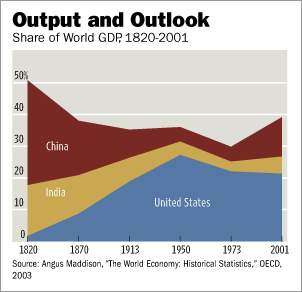
Economic History Graph
Here is an interesting graphic from the Wall Street Journal, courtesy of Economist Greg Mankiw that shows how large the GDP of the US, China, and India has been relative to the GDP of the entire world.
(Source: Greg Mankiw's Blog)

(Source: Greg Mankiw's Blog)
Monday, September 18, 2006
99 Cent Pricing
This is an age-old question: why do prices in stores end in .99 (like $1.99 instead of $2 or $19.99 instead of $20)?
The traditional explanation is that there is some psychological aspect that makes more people buy the product because it appears much cheaper even though it is only $0.01 cheaper. I buy that to a certain extent, but I feel there is also something to be gained by pricing at even numbers because people appreciate not feeling like they are being tricked. Or why not price items so that they work out to be even numbers when tax is added so that you save people from having to deal with change?
Another explanation I have heard is that it was designed to keep cashiers from pocketing money given to them by customers. Since they are given $1.99 instead of $2, the cashier has to open the register to give change.
Neither of these explanations are really satisfying, so I wanted to see what you guys thought. Another interesting idea is to think about the circumstances where pricing is a little different. Like why are gasoline companies are the only ones to give tenths of a cent on their prices? Or why do some places price in whole numbers (some fancy restaurants, used book stores, concert tickets, etc.) while most do not?
(Schulz gets credit for suggesting the question should be on the blog)
The traditional explanation is that there is some psychological aspect that makes more people buy the product because it appears much cheaper even though it is only $0.01 cheaper. I buy that to a certain extent, but I feel there is also something to be gained by pricing at even numbers because people appreciate not feeling like they are being tricked. Or why not price items so that they work out to be even numbers when tax is added so that you save people from having to deal with change?
Another explanation I have heard is that it was designed to keep cashiers from pocketing money given to them by customers. Since they are given $1.99 instead of $2, the cashier has to open the register to give change.
Neither of these explanations are really satisfying, so I wanted to see what you guys thought. Another interesting idea is to think about the circumstances where pricing is a little different. Like why are gasoline companies are the only ones to give tenths of a cent on their prices? Or why do some places price in whole numbers (some fancy restaurants, used book stores, concert tickets, etc.) while most do not?
(Schulz gets credit for suggesting the question should be on the blog)
No, Really, This Is Our Farewell Tour...
Big-time artists that have been around for awhile will many times announce a farewell tour when they plan to retire from the music business. However, you then see some bands come out of retirement after their so-called farewell, or at least extend the farewell long enough to play cities multiple times (some recent examples are Eric Clapton, Cher, and the Who). In fact, Phil Collins named his tour this summer the "First Final Farewell Tour" as reference to this phenomenon.
Clearly, bands name their tours this because it raises the revenue for the tour because people think they will never have the chance to see this band again. But on the other hand, if bands keep going back on saying it is a farewell tour, then they lose credibility and people won't be as likely to buy a ticket when it is their last tour. What are your thoughts on this whole idea? What would be the revenue-maximizing strategy for a band in this situation? What type of band could use the strategy of announcing a farewell tour? Red Hot Chili Peppers? Death Cab for Cutie? Hilary Duff? U2?
(Question from Austin)
Clearly, bands name their tours this because it raises the revenue for the tour because people think they will never have the chance to see this band again. But on the other hand, if bands keep going back on saying it is a farewell tour, then they lose credibility and people won't be as likely to buy a ticket when it is their last tour. What are your thoughts on this whole idea? What would be the revenue-maximizing strategy for a band in this situation? What type of band could use the strategy of announcing a farewell tour? Red Hot Chili Peppers? Death Cab for Cutie? Hilary Duff? U2?
(Question from Austin)
Friday, September 15, 2006
Reading a Book vs. Watching a DVD
Economist Tyler Cowen offers what I think is a very interesting question:
Another reason I would add:
(Source: Marginal Revolution)
He offers several hypotheses, but the one I find most convincing initially is:I almost always read novels in bits. That is, I put the book down for a few times before finishing it.
I rarely watch movies in bits. That just seems wrong. But, assuming we are watching on DVD, why? Why do pauses ruin a movie but not a book?
2. Most books are longer than most movies, but there is otherwise no good reason for the difference in our consumption pattern.I find this one convincing simply because if there is a book that takes less than two hours to read, I usually read it in one sitting. I tend to think that any movie over 1 hour and 45 minutes is too long, anyway, so I have no problem pausing DVDs and watching the rest later if they are over 2 hours.
Another reason I would add:
- with books, it is easier to look back at an earlier section for a piece of information if your forget, even with the scene selection on DVDs
The ever-wise Natasha notes that we are mostly likely to read action novels -- such as The da Vinci Code -- straight through without pause. But action movies are the easiest to watch in bits. Ever try just a half hour of Jackie Chan? Wonderful. But breaking up a good drama is criminal.What are your thoughts on this?
(Source: Marginal Revolution)
Wednesday, September 13, 2006
Banning Chocolate from Schools
Economist Tim Harford discusses how free markets are suppressed in some cases. The main issue he discusses is how some schools are banning candy in vending machines. The questions to go along with the article are below:
In a few very publicized cases, the government is trying to get directly involved in maintaining (or improving) the health of America's children by putting weight on report cards, removing vending machines from schools, etc. Is it important to do such things, or is it a lost cause? If so, why, and what causes the problem in the first place (like marketing of junk food directly to children)? And is there something, ultimately, that could reduce the incentive for children (and people in general) to eat junk food, or is the approach that these schools are taking (by removing the temptation entirely) the best (or is it an impossible problem to fix at all)?
(Proposed by Nicole)
Divergence Between Test Scores & Economic Performance
Nobel Prize winning Economist Gary Becker has an article posted on the following paradox:
(Source: EconLog)
One of the challenging paradoxes during the past several decades is that American teenagers have consistently performed below average on international tests in math and sciences, and not especially well on reading tests, yet the American economy is more productive than any other.One reason he gives is that the education system in the United States builds up and gets harder as you move up each level, culminating with university, while in some other countries, elementary and secondary school is harder and college is seen as a "break" or a reward for doing all of the work in the first place. I can attest to this phenomenon from observing schools and talking to students in Japan. Another interesting reason he gives that I can relate to as a teacher is that:
American schools are less oriented toward rote teaching than are schools in many other countries, and they are more oriented toward giving students practice in thinking through issues and expressing themselves in discussions.Economist Arnold Kling boils the argument down to two propositions:
Which explanation do you find most convincing? Any other explanations that may be useful?(1) International tests fail to measure the superior aspects of the U.S. education system.
(2) Education is not such an important factor in comparative economic performance.
I lean toward (2). It's better to have strong entrepreneurialism and mediocre education than the other way around.
(Source: EconLog)
Consumer Surplus from Pets
Economist Tyler Cowen has a post on how much consumer surplus people get from pets -- very timely considering what we are studying right now.
He argues that people get a lot of consumer surplus from pets because they value the pets they have very highly, but many families do not want another. Therefore, the willingness to pay for the pet they already have is relative to the price they would have to pay for the next pet (which is determined by their willingness to pay for that next pet).
He goes on in the post to discuss endowment effects and the corresponding rise in living standards, but for this post, let's stick to his idea that people get a lot of consumer surplus out of their pets. Any thoughts in agreement or disagreement?
(Source: Marginal Revolution)
He argues that people get a lot of consumer surplus from pets because they value the pets they have very highly, but many families do not want another. Therefore, the willingness to pay for the pet they already have is relative to the price they would have to pay for the next pet (which is determined by their willingness to pay for that next pet).
He goes on in the post to discuss endowment effects and the corresponding rise in living standards, but for this post, let's stick to his idea that people get a lot of consumer surplus out of their pets. Any thoughts in agreement or disagreement?
(Source: Marginal Revolution)
Tuesday, September 12, 2006
People Sleep Better on a Pile of Money
An interesting study from the Journal of American Epidemiology suggests that the rich sleep more efficiently. People with higher incomes don't sleep for more hours necessarily, but they spend less time trying to get to sleep each night (called sleep latency).
Here is a link to a graphic from the study and where I originally found out about it.
Any ideas on what your income could have to do with your sleep latency?
(Source: Marginal Revolution)
Here is a link to a graphic from the study and where I originally found out about it.
Any ideas on what your income could have to do with your sleep latency?
(Source: Marginal Revolution)
Monday, September 11, 2006
Copyrights for Fashions?
Economist Greg Mankiw points to an article in the Wall Street Journal that explains a way that designers want to stop cheap imitations of their designs:
(Source: Greg Mankiw's Blog)
prominent fashion designers in the U.S. are pushing for federal legislation that would offer three years of copyright-like protection for designs ranging from dresses and shoes to belts and eyeglass frames.What do you think of this idea? Copyrights protect intellectual property and give people more incentive to create new ideas. However, they also create temporary monopolies and drive up the price of the goods in question. Copyrights already cover written material, songs, etc. Do you think copyrights should be extended to fashions?
(Source: Greg Mankiw's Blog)
Using Economics to Put People in Jail
The Economics Focus in this week's issue of The Economist discusses how the "efficient markets hypothesis" is used in legal cases. Again, we are getting a little ahead of ourselves in the curriculum, but the "efficient markets hypothesis," as applied to the stock market, basically says that the price of a stock includes all of the public information relevant to its value. Therefore, the only reason a stock changes price is because of new information.
You can turn the hypothesis around and measure how much impact an event has on the stock price by determining how much the stock went up or down when the news came out about the event. This hypothesis was used in the legal case of a tax accountant named James Olis
(Source: Freakonomics Blog)
You can turn the hypothesis around and measure how much impact an event has on the stock price by determining how much the stock went up or down when the news came out about the event. This hypothesis was used in the legal case of a tax accountant named James Olis
His 24-year sentence stemmed from a calculation of the financial loss caused to investors in Dynegy by Project Alpha, an accounting fraud in which he took part. That financial loss was estimated using the fall in Dynegy's share price on the news that Project Alpha was fraudulent. According to Judge Lake, it was so big that, under sentencing guidelines then in place, Mr Olis had to go to jail for a long time.Any thoughts on the use of this theory to determine damages? The article discusses some of the controversy of using it.
(Source: Freakonomics Blog)
How to Best Target Foreign Aid
Foreign aid to developing nations has typically been used to fund long-term projects like infrastructure (roads, education systems, etc.). An article in Business Week from Edward Miguel says that it should be used instead to repair the short-term effects of natural catastrophes:
(Source: Marginal Revolution)
There is no link to the article, but here is a link to the Marginal Revolution post that cited it and also an opinion from economist Tyler Cowen that his issue is that he does not think the foreign aid would end up in the hands of the poor in these cases.Our research find that a 5% drop in per capita income due to drought increases the likelihod of a civil conflict [in African countries] in the following year by nearly one half. That's a very large effect.
...Currently, most foreign aid focuses on long-term investments in infrastructure of education but does little to deal with such short-term triggers of violence as drought or falling export commodity prices. But our research suggests a larger share of aid should aim to dampen the sharp falls in income that actually generate recruits for rebel movements.
(Source: Marginal Revolution)
Subscribe to:
Posts (Atom)