Friday, November 10, 2006

The Economist Blog on Overfishing

The Economist magazine has a new blog (which I am a little too excited about) called Free exchange and one of their first posts is about overfishing: why it is a problem and one possible solution.

Here is one excerpt I liked:
I have met many people who, in their quest for health and oneness with nature, eschew all meat but happily eat fish twice a day. This I find ironic, since, whatever the environmental effects of industrial farms, they are as nothing compared to the probleme of overfishing.
And another:
The counterincentives in the fishing industry, unfortunately, are particularly poor: everyone likes to eat inexpensive fish, and the fish aren't cute, or running through our back yards where we can see them.
They propose a solution where the government caps the amount of a certain fish that can be sold by restaurants and grocery stores.

Old Posts on Thomas Schelling

Since I brought him up in class, I thought i would link to two posts that I created last year about Thomas Schelling and his work on applications of game theory.

First, a summary of two his main accomplishments that I posted when he won the Nobel prize last year.

Also, a post on a concept of his called "focal points."

Feel free to add to the discussion we started last year on Schelling.

Thursday, November 09, 2006

How Education Levels Affect Marriage

Economist Greg Mankiw links to a Wall Street Journal article that examines the relationship between education levels and marriage:
increased education leads to better marriages and stronger families. College graduates are less likely to divorce -- and more specifically, families with highly educated mothers are half as likely to split. So says an upcoming article in Demographic Research by Steven P. Martin, a professor of sociology at the University of Maryland. Looking at marriages that began between 1990 and 1994, Mr. Martin found that, of marriages in which the wife had a college education (or more), only 16.5% dissolved in the first 10 years, compared with 38% in which the wife had only a high-school diploma.
Any ideas on why this connection exists?

(Source: Greg Mankiw's Blog)

Economics of Voting

In honor of the elections a few days ago, I think the question of why people vote is an interesting one. Statistically, the probability that your vote will decide the election is basically 0%. Additionally, it is costly in terms of time and effort to vote. Therefore, why do people vote? (I am not by any means saying that people should not vote, I am just interested in why people are compelled to do something that on the face of it seems to have no concrete benefit).

Here are some additional resources for the question and discussion:

Sunday, November 05, 2006

Economics of the Weather

The authors of Freakonomics have an article in the New York Times Magazine describing recent research in how the weather affects economics. Two main ideas:
  • Rainfall seems to have a significant effect on violent crime, both because increased drought tends to lead to more civil war and because riots in cities are dampened by rainfall
  • Research by two economists estimates the global warming will cause an increase in agricultural profits and mortality rates by the end of the century

Any thoughts on this research? Any other ways you can think of applying weather in economics?

(Source: Freakonomics Blog)

Thursday, November 02, 2006

What is a "ClickTip"?

Journalist Stephen Dubner discusses the practice of clicking the ads on a page that is provided for free as a tip to the author of the webpage. Since many webpages make money based on how many people click the ads that are placed on the page, by clicking the ad, you are giving them a small tip.

Stephen references a commenter on his blog:
I think The N.Y. Times and Washington Post websites are great (although I don’t pay for “Times Select” but I do think that their site has the best presentation, appearance-wise). I always try and remember to click on the ad banners once in a while to try and keep the sites free or at least much of the content free. Opening the ads in another tab on Firefox is not so disruptive. Or click and minimize.
What do you think of this practice? Do you think it is (or would be) effective? Try to put in economic terms why people do this.

(Source: Freakonomics Blog)

Tuesday, October 31, 2006

Why Do New Yorkers Smoke So Much?

Economist Tyler Cowen posts an interesting question on his blog: why do New Yorkers seem to smoke so much more than people from other places/cities? Here are the possible reasons he offers:

1. Social networkers head to Manhattan, and social networkers smoke.
2. In Manhattan it is more important to signal you are cool.
3. Air pollution is higher, so the marginal health cost of smoking is less.
4. New York is colder, and that makes cigarettes more enjoyable.
5. The "artsy" variable is doing most of the work; of course this is related to #1 and #2.
6. NYC life is more stressful, and smoking calms some of these people down.
7. Many of them are poseurs, and these smokers don't have such valuable human capital.

I'd bet first on #2, and also on #7, but I don't have a good theory that will explain the rest of the cross-sectional evidence.

Which hypothesis do you find convincing? Any additional ones to add?

(Source: Marginal Revolution)

A Boom in Halloween Industries

In honor of Halloween, today's post is about the horror genre of movies is doing really well in recent years. And actually, the "Halloween industry" in general has been doing well, from costumes to decoration. Here is an article from USA Today discussing the boom in revenues from horror movies and a new venture planned by Comcast and Sony called FearNet.

Here are some questions from Sarah:
What has casued the rise in horror genre popularity over the past few years, especially given that most movies this year are sequels or part of a series?
Do you think this new horror web site will stay in business? Is there enough of a fan base?

(From: Sarah O.)

Monday, October 30, 2006

A Fat Tax

Economist Gary Becker considers a tax on foods with saturated fat as a solution to the problem of obesity in the United States.
One proposal receiving some attention is to impose a tax on foods that contain high quantities of saturated fat in the hope of cutting down consumption of these foods. The basic law of demand states that a tax on saturated fat would raise the price of fatty foods, and thereby would reduce their consumption. A good analogy is with other "sin"taxes, such as the very heavy tax in most countries on cigarettes, or the large tax in many countries on alcoholic beverages. These taxes have greatly raised the price of these goods and reduced their consumption. For example, it is estimated that every 10% increase in the retail price of cigarettes due to higher taxes cuts smoking by about 4% after the first year, and by a considerable 7% after a few years.

He ends up arguing against the use of a tax on foods with high levels of saturated fat due to the fact that there are other major causes of obesity, the likelihood of future medical advances, and a doubt of whether it would be an effective tax.

(Source: Becker-Posner Blog)

Reminiscing About Legos

The Economist has an article this week about Lego, the Danish toy firm, and how it has turned around its business in the last year or two. Apparently, they worried too much about diversifying their business into video games and clothing instead of sticking to what they know best, which I think is making people with cylindrical heads.

Either way, it is an interesting case study of how new management comes in and reworks a firm. Also, you get this interesting tidbit of information about Lego blocks:
everyone on earth has, on average, 52 of them.

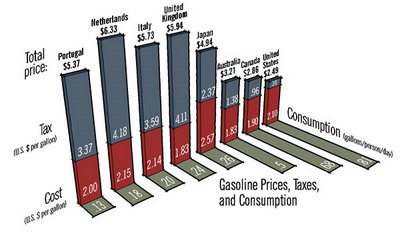
Another Interesting Graphic on Gasoline Taxes


Economist Greg Mankiw has another interesting graphic up this week on gasoline taxes. It shows basically, the law of demand, showing that where gasoline taxes are higher (which results in higher prices), those nations consume considerably less gasoline.

(Source: Greg Mankiw's Blog)

Lucky Lottery Clerks

A statistician in Canada discovered that the clearks who sold lottery tickets were winning a whole lot of prizes in the Ontario lottery. That means that they were either really lucky or they were stealing lottery prizes from elderly customers. Not the most shocking crime, but it is an interesting application of statistics.

(Source: Freakonomics Blog)

Thursday, October 26, 2006

A Prize for Good African Leaders

Part of the reason why Africa continues to be in a cycle of poverty is due to corrupt leadership in many African nations. In these cases, foreign aid is not effective because that aid typically falls into the hands of corrupt leaders and helps them stay in power at the expense of their people.

As a solution to this problem of bad/corrupt governance, an African billionaire has offered a lucrative monetary prize to any African leaders that meet certain standards of governance.

The contest, launched in London, will award winning leaders $5m (£2.7m) over 10 years when they leave office, plus $200,000 (£107,000) a year for life. The award will go to African heads of state who deliver security, health, education and economic development to their constituents.

In an interview with the Financial Times newspaper, Mr Ibrahim, 60, said leaders had no life after office. "Suddenly all the mansions, cars, food, wine is withdrawn.
Some find it difficult to rent a house in the capital. That incites corruption; it incites people to cling to power. The prize will offer essentially good
people, who may be wavering, the chance to opt for the good life after office,"

What do you think of this prize? It is actually similar to the Netflix innovation prize we discussed recently. Do you think it will be effective in combatting the corruption in many African governments?

Economist Tyler Cowen thinks the prize is too small. Here is another post about it where the author is skeptical, thinking that is gives a reward for something that should be expected.

(Source: Marginal Revolution)

Possible Solutions for the US Health Care System

Here is a discussion from Stanford Medicine Magazine with different experts weighing in on how they would fix the US health care system. Here is a question from Carrie:

How should the US healthcare system be reformed?
Which of these solutions seems that it would work the best?

(Source: Carrie S.)

Wednesday, October 25, 2006

Will Small Countries Be Bought and Sold in the Near Future?

Economist Tyler Cowen discusses the future of colonialism. Specifically, how future technologies or wealth might change the ability of more powerful countries to control weaker ones.

One idea he brings up is whether small countries may be simply bought by industrialized nations in the near future. In his words:
If the world's very poor countries stay in Malthusian traps, how long will it be before wealthy philanthropists can try to "adopt a country"? Measured Haitian gdp, for instance, is only a few billion dollars a year. Yes many countries have laws against foreign investment and land ownership, but at some point a correct strategy can put the money to good use. Can an entire corrupt government simply be bought out? Just how much money, and what kind of plan, would a private philanthropist need each year to turn Haiti around, or at least bring it to the standards of Martinique?
What do you guys think? Do you think this will happen in the forseeable future? Could it be a way to improve some countries or merely a power that will inevitably be abused?

(Source: Marginal Revolution)

Monday, October 23, 2006

Optimal Buffet Eating Strategy

Economist Tim Harford, who was mentioned in the last blog post, also has a column for the Financial Times called Dear Economist, where he gives advice from the perspective of an economist on questions that are not your typical economics questions. A recent question:

Dear Economist,

From time to time I find myself eating a meal with an unlimited supply of food: sometimes an all-you-can-eat buffet, sometimes a more sophisticated meal laid on by a friend or someone trying to impress: weddings, banquets, that kind of thing. I like food but there are limits to how much I can eat. So how should I pace myself for optimal enjoyment of the meal?

Mr M. Newman, Shrewsbury

Harford offers two strategies depending on how the food is presented:
  • try a little of everything to decide what you like before going back for the main eating fest
  • consider the incentives of the food supplier if the dishes are brought out sequentially to save room for the best food

Any thoughts on the best buffet strategy?

Are Kids Fat Because of Working Parents?

In this Slate article, Tim Harford argues that one of the reasons why more children are overweight these days is because there are more two-income families with moms working instead of staying home. In an earlier blog post, we discussed some of the other factors at work that Harford references, but this adds another idea into the mix. Here are questions to go along with the article:
In some ways, says Tim Hartford, author of the article, this makes sense: having two working parents leaves young children unsupervised, at daycare or with a nanny, who probably puts them in front of the TV and feeds them high-calorie processed foods that take less effort to prepare. And at the end of a long working day, exhausted, they may provide fast food for the children rather than cooking a traditional, nutritious meal. (Just look at it based on opportunity cost: if parents are too exhausted, the cost of cooking a meal would be much higher than the "small" weight gain associated with just one fast food meal...and then that just snowballs.) But on the other hand, for example, many kids at Walker have two working parents, and few of them are overweight. Is Hartford's proposal a plausible cause of the childhood obesity epidemic? Could it be a major player, or only one of many factors? If it is one of many, what other possible causes (within the family) could there be (i.e., parents' income levels, living in the suburbs vs. the city, even firstborn vs. second, third, etc child)?
(Source: Nicole O.)

Friday, October 20, 2006

Argument for a Higher Gasoline Tax

Economist Greg Mankiw has an article in the Wall Street Journal arguing for a $1.00 increase in the per gallon gasoline tax. He argues for the tax to be phased in by $0.10 a year for the next 10 years and offers a very clear list of reasons why he favors it.

One of his reasons harkens back to our discussion of tax incidence in Unit C:
Tax incidence. A basic principle of tax analysis -- taught in most freshman economics courses -- is that the burden of a tax is shared by consumer and producer. In this case, as a higher gas tax discouraged oil consumption, the price of oil would fall in world markets. As a result, the price of gas to consumers would rise by less than the increase in the tax. Some of the tax would in effect be paid by Saudi Arabia and Venezuela.
What do you think of his argument? If you agree, what is the most convincing aspect? If you disagree, is there a better alternative?

Celebrity Baby Names

Why do celebrities name their kids more unusual names than the general population? This may not seem like an economics question, but it involves a decision, which can always be examined from an economic perspective.

This article talks about some of the examples. There are the ones we have all heard of lately like Suri, Apple, and Shiloh. My favorites from the article are Penn Jillette's daughter named Moxie CrimeFighter and Jason Lee's son named Pilot Inspektor.

Why are celebrities choosing these names? I am not sure if the whole answer is publicity because I don't think that Tom Cruise or Brad Pitt and Angelina Jolie need more publicity than they have now.

Wednesday, October 18, 2006

An Economist also Won the Nobel Peace Prize

Last week the Nobel Peace Prize was awarded to Muhammad Yunus, who is actually known for his advances in applying economics to helping developing nations. Yunus is known for starting a microfinance organization called Grameen Bank, which gives loans to individuals in developing nations (Grameen operates in Bangladesh).

Here is a basic explanation:
One of the obstacles faced by individuals and families in developing nations is that they have a difficult time obtaining loans (for consumption or starting and running a small business, etc.). Two of the reasons why it is difficult is that poor families do not have anything to offer a collateral, and it is not cost-effective for larger banks to offer such small loans. Since they have no collateral to offer, banks have no way of ensuring repayment.

Yunus started a bank based on the fact that individuals in developing nations have strong social bonds that could be used as a type of collateral. He took advantage of these strong social bonds by having the lenders apply together in groups. If one person in the group defaults on their loan, then everyone in the group is responsible for the loan. Therefore, the bank uses social pressures (the borrower not wanting to let down or burden their peers) as a way to enforce repayment.

The bank has been incrdeibly successful and has a very high repayment rate. Overall, Yunus and Grameen Bank are an example of helping developing nations by helping them build their own economies and their own markets instead of forcing western models upon them or just throwing foreign aid money at the problem.