In Wednesday's NY Times, there is an article discussing whether there is a pattern to how works of art are priced. The article discusses the work of economist David Galenson who has found that great artists usually fall into one of two categories:
1. "Young Geniuses:" like Picasso, Van Gogh, or Gauguin, who create their most valuable works early in their career and are innovators who spend little time on their artwork.
2. "Old Masters:" like Jackson Pollock or Paul Cezanne, who create their most valuable works of art late in their career and spend a lot of time perfecting and experimenting with their artwork.
Galenson then uses these two categories to explain patterns in the creation of artwork and to predict the prices that the works of art will sell for.
One of the main topics of the article is how there is a lot of resistance to applying these economic and statistical techniques to the field of art. So my question would be, what do you think of Galenson's ideas? Is it an example of trying to bring everything under the economics/statistics umbrella without regard to whether it fits? Why do you think there is so much resistance to Galenson's work?
Friday, November 17, 2006


Another Couple Thoughts on Friedman
To add to Kroger's well-put post, Milton Friedman is the father of the author of Hidden Order, which we are currently using in class, and I will add one link: a tribute written about 10 years ago by economist Greg Mankiw. The reason I am linking to that article is that is has a quote from Milton and his wife summarizing their views on policy:
The Friedmans are best known for their articulate and unwavering defense of the free market. Their policy objective is, simply, "the promotion of human freedom." This goal, they tell us, "underlies our opposition to rent control and general wage and price controls, our support for educational choice, privatizing radio and television channels, an all-volunteer army, limitation of government spending, legalization of drugs, privatizing Social Security, free trade, and the deregulation of industry and private life to the fullest extent possible." Milton and Rose were libertarians--aggressively vocal libertarians--before libertarians were cool.
Thursday, November 16, 2006
IKEA Doesn't Follow the Textbook Example
Here is an article that discusses IKEA's unique policy on selling umbrellas:
The author of the article thinks that IKEA's strategy is a good one (though he does not give any empirical evidence). What do you think? Is IKEA's policy leaving money on the table? Or can you think of reasons why it would be a good idea for them to go against the textbook example?
(Source: Newmark's Door)
This strategy is contrary to one of the most basic examples in supply and demand analysis: when it is raining and the demand for umbrellas is high, firms can charge a higher price to make higher profits.The umbrellas are huge (3 people can fit underneath), colorful (in IKEA's signature blue and yellow with a big company logo), and made of good quality materials (strong cloth, steel shaft, large wooden handle). Exactly the kind of umbrella you want to carry when it's raining.
A small sign hangs nearby:
IKEA UMBRELLAS
Sunny Day .............. $ 10.
Rainy Day .............. $ 3.
The author of the article thinks that IKEA's strategy is a good one (though he does not give any empirical evidence). What do you think? Is IKEA's policy leaving money on the table? Or can you think of reasons why it would be a good idea for them to go against the textbook example?
(Source: Newmark's Door)
Finding Underpriced Goods on eBay
There is a business called eBooBoos whose sole business model is to find auction items on eBay that are misspelled (eBay does not have a spell checker). The idea is that when items are misspelled, people will not be able to find them, and therefore, they will be priced too low.
Another example of the ridiculous range of businesses that exist.
(Source: Marginal Revolution)
Another example of the ridiculous range of businesses that exist.
(Source: Marginal Revolution)
Wednesday, November 15, 2006
No Such Thing as a Free Drug
Marginal Revolution links to an NBER paper that compares the pharmaceutical industry in Europe to the pharmaceutical industry in the US. In Europe, phramaceutical prices are regulated by the government and are therefore lower. An unsurprising consequence:
The main point is not that the regulations are bad necessarily (you then get into an equity vs. efficiency argument), but that you can't lower prices on drugs without knowing that this action will have negative consequences somewhere else.
Results show that EU consumers enjoyed much lower pharmaceutical price inflation, however, at a cost of 46 fewer new medicines introduced by EU firms and 1680 fewer EU research jobs.The abstract of the article also discusses how US firms spend 15% more on research and development than European pharmaceutical companies.
The main point is not that the regulations are bad necessarily (you then get into an equity vs. efficiency argument), but that you can't lower prices on drugs without knowing that this action will have negative consequences somewhere else.
Tuesday, November 14, 2006
Burrito = Sandwich?
In this unit, we have talked about how companies try to set up barriers to entry in their markets. Apparently, a Panera Bread bakery in a Massachusetts mall wrote into their contract that no other sandwich shop could open in that mall. They then used that clause to try and stop a Mexican burrito place from opening in the mall.
This leads into a court having to rule whether a burrito is a sandwich. The court ruled in favor of the burrito place saying that a burrito is not a sandwich.
(Source: Greg Mankiw's Blog)
This leads into a court having to rule whether a burrito is a sandwich. The court ruled in favor of the burrito place saying that a burrito is not a sandwich.
(Source: Greg Mankiw's Blog)
Herd Mentality of Shoppers
An article in The Economist this week discusses how companies are trying to increase sales by taking advantage of consumers' herd mentality: that they are more likely to buy what other consumers buy.
Do you think this strategy will have a significant impact on sales in grocery stores? Personally, I am not sure that people buy what is "popular" when buying groceries as much as when buying music or books, but I may be underestimating the herd mentality that buyers have in general.
The idea is that, if a certain product is seen to be popular, shoppers are likely to choose it too. The challenge is to keep customers informed about what others are buying. Enter smart-cart technology. In Mr Usmani's supermarket every product has a radio frequency identification tag, a sort of barcode that uses radio waves to transmit information, and every trolley has a scanner that reads this information and relays it to a central computer. As a customer walks past a shelf of goods, a screen on the shelf tells him how many people currently in the shop have chosen that particular product. If the number is high, he is more likely to select it too.As evidence that this will work, the author references a market where people download previously unknown songs based on how they are ranked by previous downloaders and the recommendation system that Amazon uses.
Do you think this strategy will have a significant impact on sales in grocery stores? Personally, I am not sure that people buy what is "popular" when buying groceries as much as when buying music or books, but I may be underestimating the herd mentality that buyers have in general.
Sunday, November 12, 2006
Strategy for Dealing with Telemarketers
Economist Andrew Samwick has a novel strategy that he uses to deal with unsolicited phone calls. It is definitely an economic approach to the problem, factoring in the cost and benefit decision of the telemarketer:
Any other strategies that you think would work to prevent the phone calls?
(Source: Vox Baby)
Second, hanging up immediately is the non-cooperative response to this problem. When the Samwick household receives unsolicited phone calls (and I'm talking about you, Car Store), we employ either of two strategies that have a common element. If the VoxSon is feeling punchy, we let him answer the phone and have a little fun. Otherwise, we answer the phone, possibly responding that we will "go get" the person in question, and then just put the phone down.The common element here is that we keep the offender on the line as long as possible. This prevents the offender from bothering the next household on the call list until the offender terminates the call. This is the way to tax the resources (i.e. time) of the offender, making the enterprise less profitable and thus less likely in the future. If we all cooperated to employ this strategy, we would all be better off for it.The key is increasing the cost of making unsolicited phone calls, thereby affecting the cost-benefit decision of the telemarketing company. Now, the main problem that I see with his strategy is that it also imposes a small cost on himself because he cannot receive or make any calls while he has the phone off the hook (but if you are having your dinner interrupted by the call, then that is probably not a problem).
Any other strategies that you think would work to prevent the phone calls?
(Source: Vox Baby)
Friday, November 10, 2006
The Economist Blog on Overfishing
The Economist magazine has a new blog (which I am a little too excited about) called Free exchange and one of their first posts is about overfishing: why it is a problem and one possible solution.
Here is one excerpt I liked:
Here is one excerpt I liked:
I have met many people who, in their quest for health and oneness with nature, eschew all meat but happily eat fish twice a day. This I find ironic, since, whatever the environmental effects of industrial farms, they are as nothing compared to the probleme of overfishing.And another:
The counterincentives in the fishing industry, unfortunately, are particularly poor: everyone likes to eat inexpensive fish, and the fish aren't cute, or running through our back yards where we can see them.They propose a solution where the government caps the amount of a certain fish that can be sold by restaurants and grocery stores.
Old Posts on Thomas Schelling
Since I brought him up in class, I thought i would link to two posts that I created last year about Thomas Schelling and his work on applications of game theory.
First, a summary of two his main accomplishments that I posted when he won the Nobel prize last year.
Also, a post on a concept of his called "focal points."
Feel free to add to the discussion we started last year on Schelling.
First, a summary of two his main accomplishments that I posted when he won the Nobel prize last year.
Also, a post on a concept of his called "focal points."
Feel free to add to the discussion we started last year on Schelling.
Thursday, November 09, 2006
How Education Levels Affect Marriage
Economist Greg Mankiw links to a Wall Street Journal article that examines the relationship between education levels and marriage:
(Source: Greg Mankiw's Blog)
increased education leads to better marriages and stronger families. College graduates are less likely to divorce -- and more specifically, families with highly educated mothers are half as likely to split. So says an upcoming article in Demographic Research by Steven P. Martin, a professor of sociology at the University of Maryland. Looking at marriages that began between 1990 and 1994, Mr. Martin found that, of marriages in which the wife had a college education (or more), only 16.5% dissolved in the first 10 years, compared with 38% in which the wife had only a high-school diploma.Any ideas on why this connection exists?
(Source: Greg Mankiw's Blog)
Economics of Voting
In honor of the elections a few days ago, I think the question of why people vote is an interesting one. Statistically, the probability that your vote will decide the election is basically 0%. Additionally, it is costly in terms of time and effort to vote. Therefore, why do people vote? (I am not by any means saying that people should not vote, I am just interested in why people are compelled to do something that on the face of it seems to have no concrete benefit).
Here are some additional resources for the question and discussion:
Here are some additional resources for the question and discussion:
- Here is a post from last year where I pose the same question.
- An article from economist Greg Mankiw on why he thinks some people should not vote.
Sunday, November 05, 2006
Economics of the Weather
The authors of Freakonomics have an article in the New York Times Magazine describing recent research in how the weather affects economics. Two main ideas:
- Rainfall seems to have a significant effect on violent crime, both because increased drought tends to lead to more civil war and because riots in cities are dampened by rainfall
- Research by two economists estimates the global warming will cause an increase in agricultural profits and mortality rates by the end of the century
Any thoughts on this research? Any other ways you can think of applying weather in economics?
(Source: Freakonomics Blog)
Thursday, November 02, 2006
What is a "ClickTip"?
Journalist Stephen Dubner discusses the practice of clicking the ads on a page that is provided for free as a tip to the author of the webpage. Since many webpages make money based on how many people click the ads that are placed on the page, by clicking the ad, you are giving them a small tip.
Stephen references a commenter on his blog:
(Source: Freakonomics Blog)
Stephen references a commenter on his blog:
I think The N.Y. Times and Washington Post websites are great (although I don’t pay for “Times Select” but I do think that their site has the best presentation, appearance-wise). I always try and remember to click on the ad banners once in a while to try and keep the sites free or at least much of the content free. Opening the ads in another tab on Firefox is not so disruptive. Or click and minimize.What do you think of this practice? Do you think it is (or would be) effective? Try to put in economic terms why people do this.
(Source: Freakonomics Blog)
Tuesday, October 31, 2006
Why Do New Yorkers Smoke So Much?
Economist Tyler Cowen posts an interesting question on his blog: why do New Yorkers seem to smoke so much more than people from other places/cities? Here are the possible reasons he offers:
(Source: Marginal Revolution)
Which hypothesis do you find convincing? Any additional ones to add?1. Social networkers head to Manhattan, and social networkers smoke.
2. In Manhattan it is more important to signal you are cool.
3. Air pollution is higher, so the marginal health cost of smoking is less.
4. New York is colder, and that makes cigarettes more enjoyable.
5. The "artsy" variable is doing most of the work; of course this is related to #1 and #2.
6. NYC life is more stressful, and smoking calms some of these people down.
7. Many of them are poseurs, and these smokers don't have such valuable human capital.I'd bet first on #2, and also on #7, but I don't have a good theory that will explain the rest of the cross-sectional evidence.
(Source: Marginal Revolution)
A Boom in Halloween Industries
In honor of Halloween, today's post is about the horror genre of movies is doing really well in recent years. And actually, the "Halloween industry" in general has been doing well, from costumes to decoration. Here is an article from USA Today discussing the boom in revenues from horror movies and a new venture planned by Comcast and Sony called FearNet.
Here are some questions from Sarah:
(From: Sarah O.)
Here are some questions from Sarah:
What has casued the rise in horror genre popularity over the past few years, especially given that most movies this year are sequels or part of a series?
Do you think this new horror web site will stay in business? Is there enough of a fan base?
(From: Sarah O.)
Monday, October 30, 2006
A Fat Tax
Economist Gary Becker considers a tax on foods with saturated fat as a solution to the problem of obesity in the United States.
One proposal receiving some attention is to impose a tax on foods that contain high quantities of saturated fat in the hope of cutting down consumption of these foods. The basic law of demand states that a tax on saturated fat would raise the price of fatty foods, and thereby would reduce their consumption. A good analogy is with other "sin"taxes, such as the very heavy tax in most countries on cigarettes, or the large tax in many countries on alcoholic beverages. These taxes have greatly raised the price of these goods and reduced their consumption. For example, it is estimated that every 10% increase in the retail price of cigarettes due to higher taxes cuts smoking by about 4% after the first year, and by a considerable 7% after a few years.
He ends up arguing against the use of a tax on foods with high levels of saturated fat due to the fact that there are other major causes of obesity, the likelihood of future medical advances, and a doubt of whether it would be an effective tax.
(Source: Becker-Posner Blog)
Reminiscing About Legos
The Economist has an article this week about Lego, the Danish toy firm, and how it has turned around its business in the last year or two. Apparently, they worried too much about diversifying their business into video games and clothing instead of sticking to what they know best, which I think is making people with cylindrical heads.
Either way, it is an interesting case study of how new management comes in and reworks a firm. Also, you get this interesting tidbit of information about Lego blocks:
Either way, it is an interesting case study of how new management comes in and reworks a firm. Also, you get this interesting tidbit of information about Lego blocks:
everyone on earth has, on average, 52 of them.
Another Interesting Graphic on Gasoline Taxes
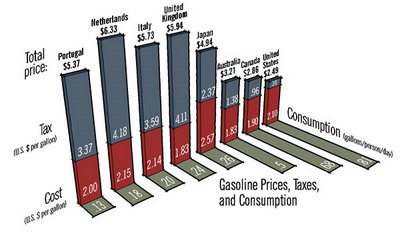
Economist Greg Mankiw has another interesting graphic up this week on gasoline taxes. It shows basically, the law of demand, showing that where gasoline taxes are higher (which results in higher prices), those nations consume considerably less gasoline.
(Source: Greg Mankiw's Blog)
Lucky Lottery Clerks
A statistician in Canada discovered that the clearks who sold lottery tickets were winning a whole lot of prizes in the Ontario lottery. That means that they were either really lucky or they were stealing lottery prizes from elderly customers. Not the most shocking crime, but it is an interesting application of statistics.
(Source: Freakonomics Blog)
(Source: Freakonomics Blog)
Subscribe to:
Posts (Atom)