Since I brought him up in class, I thought i would link to two posts that I created last year about Thomas Schelling and his work on applications of game theory.
First, a summary of two his main accomplishments that I posted when he won the Nobel prize last year.
Also, a post on a concept of his called "focal points."
Feel free to add to the discussion we started last year on Schelling.
Friday, November 10, 2006


Thursday, November 09, 2006
How Education Levels Affect Marriage
Economist Greg Mankiw links to a Wall Street Journal article that examines the relationship between education levels and marriage:
(Source: Greg Mankiw's Blog)
increased education leads to better marriages and stronger families. College graduates are less likely to divorce -- and more specifically, families with highly educated mothers are half as likely to split. So says an upcoming article in Demographic Research by Steven P. Martin, a professor of sociology at the University of Maryland. Looking at marriages that began between 1990 and 1994, Mr. Martin found that, of marriages in which the wife had a college education (or more), only 16.5% dissolved in the first 10 years, compared with 38% in which the wife had only a high-school diploma.Any ideas on why this connection exists?
(Source: Greg Mankiw's Blog)
Economics of Voting
In honor of the elections a few days ago, I think the question of why people vote is an interesting one. Statistically, the probability that your vote will decide the election is basically 0%. Additionally, it is costly in terms of time and effort to vote. Therefore, why do people vote? (I am not by any means saying that people should not vote, I am just interested in why people are compelled to do something that on the face of it seems to have no concrete benefit).
Here are some additional resources for the question and discussion:
Here are some additional resources for the question and discussion:
- Here is a post from last year where I pose the same question.
- An article from economist Greg Mankiw on why he thinks some people should not vote.
Sunday, November 05, 2006
Economics of the Weather
The authors of Freakonomics have an article in the New York Times Magazine describing recent research in how the weather affects economics. Two main ideas:
- Rainfall seems to have a significant effect on violent crime, both because increased drought tends to lead to more civil war and because riots in cities are dampened by rainfall
- Research by two economists estimates the global warming will cause an increase in agricultural profits and mortality rates by the end of the century
Any thoughts on this research? Any other ways you can think of applying weather in economics?
(Source: Freakonomics Blog)
Thursday, November 02, 2006
What is a "ClickTip"?
Journalist Stephen Dubner discusses the practice of clicking the ads on a page that is provided for free as a tip to the author of the webpage. Since many webpages make money based on how many people click the ads that are placed on the page, by clicking the ad, you are giving them a small tip.
Stephen references a commenter on his blog:
(Source: Freakonomics Blog)
Stephen references a commenter on his blog:
I think The N.Y. Times and Washington Post websites are great (although I don’t pay for “Times Select” but I do think that their site has the best presentation, appearance-wise). I always try and remember to click on the ad banners once in a while to try and keep the sites free or at least much of the content free. Opening the ads in another tab on Firefox is not so disruptive. Or click and minimize.What do you think of this practice? Do you think it is (or would be) effective? Try to put in economic terms why people do this.
(Source: Freakonomics Blog)
Tuesday, October 31, 2006
Why Do New Yorkers Smoke So Much?
Economist Tyler Cowen posts an interesting question on his blog: why do New Yorkers seem to smoke so much more than people from other places/cities? Here are the possible reasons he offers:
(Source: Marginal Revolution)
Which hypothesis do you find convincing? Any additional ones to add?1. Social networkers head to Manhattan, and social networkers smoke.
2. In Manhattan it is more important to signal you are cool.
3. Air pollution is higher, so the marginal health cost of smoking is less.
4. New York is colder, and that makes cigarettes more enjoyable.
5. The "artsy" variable is doing most of the work; of course this is related to #1 and #2.
6. NYC life is more stressful, and smoking calms some of these people down.
7. Many of them are poseurs, and these smokers don't have such valuable human capital.I'd bet first on #2, and also on #7, but I don't have a good theory that will explain the rest of the cross-sectional evidence.
(Source: Marginal Revolution)
A Boom in Halloween Industries
In honor of Halloween, today's post is about the horror genre of movies is doing really well in recent years. And actually, the "Halloween industry" in general has been doing well, from costumes to decoration. Here is an article from USA Today discussing the boom in revenues from horror movies and a new venture planned by Comcast and Sony called FearNet.
Here are some questions from Sarah:
(From: Sarah O.)
Here are some questions from Sarah:
What has casued the rise in horror genre popularity over the past few years, especially given that most movies this year are sequels or part of a series?
Do you think this new horror web site will stay in business? Is there enough of a fan base?
(From: Sarah O.)
Monday, October 30, 2006
A Fat Tax
Economist Gary Becker considers a tax on foods with saturated fat as a solution to the problem of obesity in the United States.
One proposal receiving some attention is to impose a tax on foods that contain high quantities of saturated fat in the hope of cutting down consumption of these foods. The basic law of demand states that a tax on saturated fat would raise the price of fatty foods, and thereby would reduce their consumption. A good analogy is with other "sin"taxes, such as the very heavy tax in most countries on cigarettes, or the large tax in many countries on alcoholic beverages. These taxes have greatly raised the price of these goods and reduced their consumption. For example, it is estimated that every 10% increase in the retail price of cigarettes due to higher taxes cuts smoking by about 4% after the first year, and by a considerable 7% after a few years.
He ends up arguing against the use of a tax on foods with high levels of saturated fat due to the fact that there are other major causes of obesity, the likelihood of future medical advances, and a doubt of whether it would be an effective tax.
(Source: Becker-Posner Blog)
Reminiscing About Legos
The Economist has an article this week about Lego, the Danish toy firm, and how it has turned around its business in the last year or two. Apparently, they worried too much about diversifying their business into video games and clothing instead of sticking to what they know best, which I think is making people with cylindrical heads.
Either way, it is an interesting case study of how new management comes in and reworks a firm. Also, you get this interesting tidbit of information about Lego blocks:
Either way, it is an interesting case study of how new management comes in and reworks a firm. Also, you get this interesting tidbit of information about Lego blocks:
everyone on earth has, on average, 52 of them.
Another Interesting Graphic on Gasoline Taxes
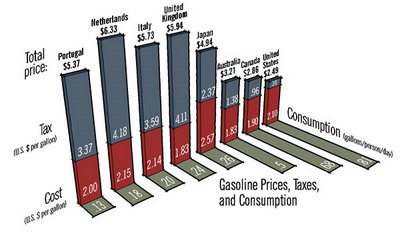
Economist Greg Mankiw has another interesting graphic up this week on gasoline taxes. It shows basically, the law of demand, showing that where gasoline taxes are higher (which results in higher prices), those nations consume considerably less gasoline.
(Source: Greg Mankiw's Blog)
Lucky Lottery Clerks
A statistician in Canada discovered that the clearks who sold lottery tickets were winning a whole lot of prizes in the Ontario lottery. That means that they were either really lucky or they were stealing lottery prizes from elderly customers. Not the most shocking crime, but it is an interesting application of statistics.
(Source: Freakonomics Blog)
(Source: Freakonomics Blog)
Thursday, October 26, 2006
A Prize for Good African Leaders
Part of the reason why Africa continues to be in a cycle of poverty is due to corrupt leadership in many African nations. In these cases, foreign aid is not effective because that aid typically falls into the hands of corrupt leaders and helps them stay in power at the expense of their people.
As a solution to this problem of bad/corrupt governance, an African billionaire has offered a lucrative monetary prize to any African leaders that meet certain standards of governance.
As a solution to this problem of bad/corrupt governance, an African billionaire has offered a lucrative monetary prize to any African leaders that meet certain standards of governance.
The contest, launched in London, will award winning leaders $5m (£2.7m) over 10 years when they leave office, plus $200,000 (£107,000) a year for life. The award will go to African heads of state who deliver security, health, education and economic development to their constituents.
In an interview with the Financial Times newspaper, Mr Ibrahim, 60, said leaders had no life after office. "Suddenly all the mansions, cars, food, wine is withdrawn.
Some find it difficult to rent a house in the capital. That incites corruption; it incites people to cling to power. The prize will offer essentially good
people, who may be wavering, the chance to opt for the good life after office,"
What do you think of this prize? It is actually similar to the Netflix innovation prize we discussed recently. Do you think it will be effective in combatting the corruption in many African governments?
Economist Tyler Cowen thinks the prize is too small. Here is another post about it where the author is skeptical, thinking that is gives a reward for something that should be expected.
(Source: Marginal Revolution)
Possible Solutions for the US Health Care System
Here is a discussion from Stanford Medicine Magazine with different experts weighing in on how they would fix the US health care system. Here is a question from Carrie:
(Source: Carrie S.)How should the US healthcare system be reformed?
Which of these solutions seems that it would work the best?
Wednesday, October 25, 2006
Will Small Countries Be Bought and Sold in the Near Future?
Economist Tyler Cowen discusses the future of colonialism. Specifically, how future technologies or wealth might change the ability of more powerful countries to control weaker ones.
One idea he brings up is whether small countries may be simply bought by industrialized nations in the near future. In his words:
(Source: Marginal Revolution)
One idea he brings up is whether small countries may be simply bought by industrialized nations in the near future. In his words:
If the world's very poor countries stay in Malthusian traps, how long will it be before wealthy philanthropists can try to "adopt a country"? Measured Haitian gdp, for instance, is only a few billion dollars a year. Yes many countries have laws against foreign investment and land ownership, but at some point a correct strategy can put the money to good use. Can an entire corrupt government simply be bought out? Just how much money, and what kind of plan, would a private philanthropist need each year to turn Haiti around, or at least bring it to the standards of Martinique?What do you guys think? Do you think this will happen in the forseeable future? Could it be a way to improve some countries or merely a power that will inevitably be abused?
(Source: Marginal Revolution)
Monday, October 23, 2006
Optimal Buffet Eating Strategy
Economist Tim Harford, who was mentioned in the last blog post, also has a column for the Financial Times called Dear Economist, where he gives advice from the perspective of an economist on questions that are not your typical economics questions. A recent question:
Harford offers two strategies depending on how the food is presented:Dear Economist,
From time to time I find myself eating a meal with an unlimited supply of food: sometimes an all-you-can-eat buffet, sometimes a more sophisticated meal laid on by a friend or someone trying to impress: weddings, banquets, that kind of thing. I like food but there are limits to how much I can eat. So how should I pace myself for optimal enjoyment of the meal?
Mr M. Newman, Shrewsbury
- try a little of everything to decide what you like before going back for the main eating fest
- consider the incentives of the food supplier if the dishes are brought out sequentially to save room for the best food
Any thoughts on the best buffet strategy?
Are Kids Fat Because of Working Parents?
In this Slate article, Tim Harford argues that one of the reasons why more children are overweight these days is because there are more two-income families with moms working instead of staying home. In an earlier blog post, we discussed some of the other factors at work that Harford references, but this adds another idea into the mix. Here are questions to go along with the article:
In some ways, says Tim Hartford, author of the article, this makes sense: having two working parents leaves young children unsupervised, at daycare or with a nanny, who probably puts them in front of the TV and feeds them high-calorie processed foods that take less effort to prepare. And at the end of a long working day, exhausted, they may provide fast food for the children rather than cooking a traditional, nutritious meal. (Just look at it based on opportunity cost: if parents are too exhausted, the cost of cooking a meal would be much higher than the "small" weight gain associated with just one fast food meal...and then that just snowballs.) But on the other hand, for example, many kids at Walker have two working parents, and few of them are overweight. Is Hartford's proposal a plausible cause of the childhood obesity epidemic? Could it be a major player, or only one of many factors? If it is one of many, what other possible causes (within the family) could there be (i.e., parents' income levels, living in the suburbs vs. the city, even firstborn vs. second, third, etc child)?(Source: Nicole O.)
Friday, October 20, 2006
Argument for a Higher Gasoline Tax
Economist Greg Mankiw has an article in the Wall Street Journal arguing for a $1.00 increase in the per gallon gasoline tax. He argues for the tax to be phased in by $0.10 a year for the next 10 years and offers a very clear list of reasons why he favors it.
One of his reasons harkens back to our discussion of tax incidence in Unit C:
One of his reasons harkens back to our discussion of tax incidence in Unit C:
Tax incidence. A basic principle of tax analysis -- taught in most freshman economics courses -- is that the burden of a tax is shared by consumer and producer. In this case, as a higher gas tax discouraged oil consumption, the price of oil would fall in world markets. As a result, the price of gas to consumers would rise by less than the increase in the tax. Some of the tax would in effect be paid by Saudi Arabia and Venezuela.What do you think of his argument? If you agree, what is the most convincing aspect? If you disagree, is there a better alternative?
Celebrity Baby Names
Why do celebrities name their kids more unusual names than the general population? This may not seem like an economics question, but it involves a decision, which can always be examined from an economic perspective.
This article talks about some of the examples. There are the ones we have all heard of lately like Suri, Apple, and Shiloh. My favorites from the article are Penn Jillette's daughter named Moxie CrimeFighter and Jason Lee's son named Pilot Inspektor.
Why are celebrities choosing these names? I am not sure if the whole answer is publicity because I don't think that Tom Cruise or Brad Pitt and Angelina Jolie need more publicity than they have now.
This article talks about some of the examples. There are the ones we have all heard of lately like Suri, Apple, and Shiloh. My favorites from the article are Penn Jillette's daughter named Moxie CrimeFighter and Jason Lee's son named Pilot Inspektor.
Why are celebrities choosing these names? I am not sure if the whole answer is publicity because I don't think that Tom Cruise or Brad Pitt and Angelina Jolie need more publicity than they have now.
Wednesday, October 18, 2006
An Economist also Won the Nobel Peace Prize
Last week the Nobel Peace Prize was awarded to Muhammad Yunus, who is actually known for his advances in applying economics to helping developing nations. Yunus is known for starting a microfinance organization called Grameen Bank, which gives loans to individuals in developing nations (Grameen operates in Bangladesh).
Here is a basic explanation:
One of the obstacles faced by individuals and families in developing nations is that they have a difficult time obtaining loans (for consumption or starting and running a small business, etc.). Two of the reasons why it is difficult is that poor families do not have anything to offer a collateral, and it is not cost-effective for larger banks to offer such small loans. Since they have no collateral to offer, banks have no way of ensuring repayment.
Yunus started a bank based on the fact that individuals in developing nations have strong social bonds that could be used as a type of collateral. He took advantage of these strong social bonds by having the lenders apply together in groups. If one person in the group defaults on their loan, then everyone in the group is responsible for the loan. Therefore, the bank uses social pressures (the borrower not wanting to let down or burden their peers) as a way to enforce repayment.
The bank has been incrdeibly successful and has a very high repayment rate. Overall, Yunus and Grameen Bank are an example of helping developing nations by helping them build their own economies and their own markets instead of forcing western models upon them or just throwing foreign aid money at the problem.
Here is a basic explanation:
One of the obstacles faced by individuals and families in developing nations is that they have a difficult time obtaining loans (for consumption or starting and running a small business, etc.). Two of the reasons why it is difficult is that poor families do not have anything to offer a collateral, and it is not cost-effective for larger banks to offer such small loans. Since they have no collateral to offer, banks have no way of ensuring repayment.
Yunus started a bank based on the fact that individuals in developing nations have strong social bonds that could be used as a type of collateral. He took advantage of these strong social bonds by having the lenders apply together in groups. If one person in the group defaults on their loan, then everyone in the group is responsible for the loan. Therefore, the bank uses social pressures (the borrower not wanting to let down or burden their peers) as a way to enforce repayment.
The bank has been incrdeibly successful and has a very high repayment rate. Overall, Yunus and Grameen Bank are an example of helping developing nations by helping them build their own economies and their own markets instead of forcing western models upon them or just throwing foreign aid money at the problem.
Edmund Phelps Wins the Nobel Prize in Economics
The announcement was really about a week ago, but I have not gotten around to posting about this until now. Edmund Phelps is a macroeconomist, so his accomplishments will not mean as much until next semester.
His main contribution is the idea of a natural rate of unemployment, which is a certain level of unemployment that will exist even when the economy is functioning at its potential. He also wrote about the importance of inflationary expectations -- the fact that it matters what people think inflation is going to be in the future.
Phelps is honestly not an economist whose work I know very well, but here is the press release announcing what he got the award for, and here is a summary of his accomplishments by economist Tyler Cowen.
His main contribution is the idea of a natural rate of unemployment, which is a certain level of unemployment that will exist even when the economy is functioning at its potential. He also wrote about the importance of inflationary expectations -- the fact that it matters what people think inflation is going to be in the future.
Phelps is honestly not an economist whose work I know very well, but here is the press release announcing what he got the award for, and here is a summary of his accomplishments by economist Tyler Cowen.
Tuesday, October 17, 2006
Optimal Charitable Giving Strategies
Tim Harford has an article in Slate that talks about the economics of charitable giving. The part that I think is most interesting is when he argues that we should give only to one cause to maximize the effectiveness of our charitable giving. Here is his explanation:
(Source: Marginal Revolution)
Economist Tyler Cowen discusses this article and gives another argument for giving to only one charity:Even the way we choose to dole out cash betrays our true motives. Someone with $100 to give away and a world full of worthy causes should choose the worthiest and write the check. We don't. Instead, we give $5 for a LiveStrong bracelet, pledge $25 to Save the Children, another $25 to AIDS research, and so on. But $25 is not going to find a cure for AIDS. Either it's the best cause and deserves the entire $100, or it's not and some other cause does. The scattershot approach simply proves that we're more interested in feeling good than doing good.
Many people are unconvinced by this argument—which I owe to Steven Landsburg—because they are used to diversifying their financial investments (a bit of Google stock and a bit of Exxon, too) and varying their choices (vanilla ice cream AND bananas). But those instincts are selfish: They are not intended to benefit both Google and Exxon, nor both the ice-cream company and the banana growers. With charity, the logic is different, and a truly selfless donor would bite the bullet and put his entire donation behind one cause. That we find that so hard to imagine is just one more indication of how hard it is for us to think ourselves into a truly selfless view of the world.
None of this is to say that these contributions are worthless or economically insignificant. Just don't get too starry-eyed about the motives behind them.
I agree with Harford's point in a different regard. The fixed costs of processing a donation are relatively high, if only because the charity will send further letters asking for more money. For that reason it may be better to focus our giving on a single charity.What do you think? If you had $1,000 to give, what strategy would yield the biggest impact?
(Source: Marginal Revolution)
Doggie Ice Cream
Good Humour is going to start making ice cream sandwiches for dogs.
(Source: Marginal Revolution)
Why do you think there would be a market for this? You could also argue why there will not be a market for this (or why no one will buy it as long as they have that horrendous slogan).Companies appear to be on a never-ending quest for ways to pamper your pooch, and here's the latest evidence: Ice cream maker Good Humor and pet food producer Pedigree have announced plans to produce ice cream sandwiches for dogs.
Apparently this is not a stupid pet snack. The companies said they needed a special formula for the dairy treats, as many dogs are lactose intolerant and cannot easily digest regular ice cream. Pedigree Ice Cream Sandwich Treats for Dogs will be dairy-based and have the same texture as ice cream, but contain only 1 percent lactose. The treats also will have added protein and no sugar, and are "pawsitively delicious," the firms' press release exclaims. A package containing 6 frozen yummies will
sell for $3.99.
(Source: Marginal Revolution)
Thursday, October 12, 2006
Rising Prices of Cancer Drugs
The NY Times this week has an article about the skyrocketing prices of cancer treatment drugs. They profile a new drug called Abraxane that costs $4,200 per dose, and is considered to be only a marginal improvement (if at all) over the older, much cheaper drug. The article also highlights the reasons why the prices of cancer drugs are increasing so much:
The rise in cancer-drug prices is a microcosm of broader trends pushing up health care costs nationally. Despite decades of efforts by governments and insurers to restrain costs, patients continue to want the newest — and most expensive — drugs and medical devices. And doctors and the health care industry have little reason to keep costs in check, because insurers rarely deny coverage for new treatments on the basis of price.And the insurance companies are not the only ones that face the higher price:
Drug industry experts say Abraxane’s price reflects the fact that makers of cancer drugs can charge high prices for new medicines even if they are only marginally better than their older counterparts. That pricing dynamic is enabled by insurance, which shields patients from the full price of drugs. Without pressure from their insurers, patients have little reason to choose older treatments over expensive new therapies.
Even if they have insurance, many patients face co-payments of 20 percent for their cancer drugs, an expense that can become ruinous for patients receiving combination therapy with several new drugs. For example, Abraxane is being tested along with Avastin, a treatment from Genentech that costs $8,000 a month for some patients.Here are some questions that go along with the article from Sarah:
Drug costs are rising so fast that some patients cannot afford the newest treatments, and access to some therapies “is beginning to be eroded,” Ms. Hinestrosa said.
What are the problems of this current system and what can be done to limit the prices of these not even miracle drugs? What are the long term effects of this trend and is it caused only by increased demand by consumers?(Question posed by Sarah O.)
World Gasoline Taxes
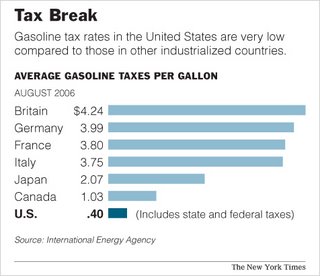
Below is a graph showing the taxes on gasoline in industrialized countries from the NY Times this week:
 (Source: Greg Mankiw's Blog)
 (Source: Greg Mankiw's Blog)
Netflix $1 Million Contest
Netflix is offering $1 million to anyone who can beat their movie recommendation system, which recommends movies based on whether people liked or disliked other movies. They have a dataset of anonymous movie ratings, and your system would have to predict what movies people will like at least 10% better than the system that Netflix currently uses.
Here is an overview of the basic rules. You can look at how the teams competing for the prize are doing here.
Here is the take of Economist Steven Levitt:
If you do agree that it is a brilliant strategy, why don't more companies use this method of innovating?
(Source: Freakonomics Blog)
Here is an overview of the basic rules. You can look at how the teams competing for the prize are doing here.
Here is the take of Economist Steven Levitt:
I love the Netflix approach to the problem. They could easily spend $1 million internally hiring some programmers or Ph.D’s to try to improve their algorithm, with uncertain results. Instead, by making it a contest and offering up data to outsiders, they will probably succeed in having 100 times as many person-hours devoted to the problem for the same price—or cheaper because they only pay out the million if someone really improves on what they are doing now. In addition they gets lots of free publicity. Truly a brilliant strategy.Do you agree that it is a brilliant strategy? Is there any downside to this strategy?
If you do agree that it is a brilliant strategy, why don't more companies use this method of innovating?
(Source: Freakonomics Blog)
Another Downside to Quantity Restrictions on Organs
Economist Alex Tabarrok discusses a further danger of the ban on organ sales: lack of experience in transplants. He argues that due to the shortage of organs, many hospitals only do a few transaplants a year and therefore are more likely to make mistakes due to the inexperience and lack of practice.
This post is timely since you guys did a paper on the possibility of the organ market just a few weeks ago and adds an argument that I had not heard before.
(Source: Marginal Revolution)
Medicare requires that transplant centers perform 12 transplants a year to be certified but many programs are in violation of that standard with little consequence. Medicare is even thinking of reducing the standard from 12 per year to 9 in 30 months. As one specialist says "I wouldn't take my car to be serviced by someone who repaired nine cars over the past three years. Would anyone do that?"He references an article and graph in the Washington Post that discusses the fact that many hospitals are currently falling short of this mark.
This post is timely since you guys did a paper on the possibility of the organ market just a few weeks ago and adds an argument that I had not heard before.
(Source: Marginal Revolution)
7-11 and the White Sox
The Chicago White Sox and the convenience store chain of 7-11 struck a marketing deal where the start time of all White Sox home games for the next 3 years will be 7:11pm. The deal will pay $500,000 a year to the team.
This is a creative advertising strategy and a way to create value and exchange from a starting time where there was not value being traded before. Do you think it will be worth it for both groups? Is this a good business decision for both sides?
This is a creative advertising strategy and a way to create value and exchange from a starting time where there was not value being traded before. Do you think it will be worth it for both groups? Is this a good business decision for both sides?
Friday, October 06, 2006
How to Allocate Flu Vaccines?
In the Wall Street Journal today, there is an article that discusses the important, but tricky question of how limited vaccines should be allocated in the event of a national emergency. The question is relevant due to concerns that have arisen over the past few years over the avian flu.
The author of the article, Sharon Begley, reports on a paper that questions the conventional wisdom on the issue:
This is a pretty controversial question, so I urge you to read the whole article before commenting and to keep the comments civil and well thought-out.
(Source: Greg Mankiw's Blog)
The author of the article, Sharon Begley, reports on a paper that questions the conventional wisdom on the issue:
What do you guys think? If you only have a certain number of vaccines, who should get first priority?In May, scientists at the National Institutes of Health stirred things up with a paper calling into question the policy that aims to save the most lives by first vaccinating the old, the very young and the sick, putting last those who are two to 64 years of age.
The value of a life, they argued, depends on age. A 60-year-old has invested a lot (measured by education and experience) in his life, but has also reaped most of the returns. A child has minimal investment. A 20-year-old has great investment but has reaped almost none of the returns. Conclusion: To maximize investment in a life plus years of life left, 13- to 40-year-olds should have first claim on rationed vaccine, explains NIH's Ezekiel Emanuel.
This is a pretty controversial question, so I urge you to read the whole article before commenting and to keep the comments civil and well thought-out.
(Source: Greg Mankiw's Blog)
What type of economist should get the Nobel Prize?
I know that I have been posting about nothing but the Nobel Prize this past week, so you guys might be tired of it, but has been a convenient way to introduce you to the work of current economists.
Economist Greg Mankiw has an interesting question posted on his blog about what type of economist tends to get the Nobel Prize. He states that
Economist Greg Mankiw has an interesting question posted on his blog about what type of economist tends to get the Nobel Prize. He states that
What do you guys think? Should they be giving Nobel Prizes to the economists that come up with a few pathbreaking ideas (the home run hitters)? Or to economists that have larger quantities of consistent, solid research (the batting average leaders)? Which would be better for the field of economics? Which would be better for society as a whole in terms of advancing knowledge and having better economic policies?There was an apparent consensus that the Nobel committee prefers rewarding people for a few path-breaking works, rather than judging an entire career of contributions. Is this optimal?
If the goal is to provide researchers with the right incentives, it may not be. It is as if a baseball team paid players based only on the number of home runs. We would have too many players swinging for the bleachers and too few base hits. In economics, maybe we get too many of the best people trying to create new paradigms and too few engaged in more routine, applied research.
Ig Nobel Prizes
Since we have been discussing the impending Nobel Prizes, the "Ig Nobel" Prizes are also given out each year, and they are a lot less prestigious, but also a lot more entertaining. They are given out for research that is unusual and/or humorous, and as I quoted last year on this blog, for research that "cannot or should not be reproduced."
A list of this year's winners are listed here.
A couple of the more unusual ones:
A list of this year's winners are listed here.
A couple of the more unusual ones:
ORNITHOLOGY: Ivan R. Schwab, of the University of California Davis, and the late Philip R.A. May of the University of California Los Angeles, for exploring and explaining why woodpeckers don't get headaches.
CHEMISTRY: Antonio Mulet, José Javier Benedito and José Bon of the University of Valencia, Spain, and Carmen Rosselló of the University of Illes Balears, in Palma de Mallorca, Spain, for their study "Ultrasonic Velocity in Cheddar Cheese as Affected by Temperature."
Wednesday, October 04, 2006
Nobel Series: William Baumol
William Baumol is an economist at NYU and was the co-author of the intro textbook that I used in college. The main theory of his that I am familiar with and would like to highlight is called "Baumol's cost disease," which sounds more gruesome than it is.
Basically, Baumol's cost disease explains why productivity grows so fast in some sectors while it lags behind in others. In particular, the term refers to the fact that it is difficult to increase productivity in labor-intensive industries, like the arts or education. To use an example from Baumol himself, it takes the same amount of musicians to play a string quartet as it did 300 years ago. Or to use an example from education, the number of students that can be taught by one teacher is the same as it was 50 years ago. In fact, it may even be less now since there is more of a focus on low student-teacher ratios.
Therefore, while other industries like manufacturing clothing and printing books become more productive due to technological innovation, service industries do not due to the fact that they are labor-intensive goods. Therefore, the costs to produce those service goods remains higher than other goods. This could be an explanation for why the prices of medical care and tuition have been increasing so much while the prices of computers and most other manufactures have been decreasing or increasing at a slower rate.
Here is an article from The New Yorker that discusses the application of Baumol's cost disease further and references a newer study that confirms these ideas.
Can you think of any other examples of industries or goods and services that suffer from Baumol's cost disease?
Basically, Baumol's cost disease explains why productivity grows so fast in some sectors while it lags behind in others. In particular, the term refers to the fact that it is difficult to increase productivity in labor-intensive industries, like the arts or education. To use an example from Baumol himself, it takes the same amount of musicians to play a string quartet as it did 300 years ago. Or to use an example from education, the number of students that can be taught by one teacher is the same as it was 50 years ago. In fact, it may even be less now since there is more of a focus on low student-teacher ratios.
Therefore, while other industries like manufacturing clothing and printing books become more productive due to technological innovation, service industries do not due to the fact that they are labor-intensive goods. Therefore, the costs to produce those service goods remains higher than other goods. This could be an explanation for why the prices of medical care and tuition have been increasing so much while the prices of computers and most other manufactures have been decreasing or increasing at a slower rate.
Here is an article from The New Yorker that discusses the application of Baumol's cost disease further and references a newer study that confirms these ideas.
Can you think of any other examples of industries or goods and services that suffer from Baumol's cost disease?
Tuesday, October 03, 2006
Nobel Series: Gordon Tullock
Another economist who has been discussed as a possible Nobel winner is Gordon Tullock. Dr. Tullock is known for his work in public choice economics (which basically applies economic logic to how government makes decisions). He is mostly known for introducing the idea of "rent-seeking behavior."
Rent-seeking behavior is where an individual or business seeks to gain by changing the economic environment instead of through a productive activity. To make the idea more clear, here are some examples:
Rent-seeking behavior is where an individual or business seeks to gain by changing the economic environment instead of through a productive activity. To make the idea more clear, here are some examples:
- A group of businesses join together to form a cartel and agree to raise prices.
- An industry pays lobbyists to get Congress to pass a bill giving subsidies to the industry.
- One country invades another to take natural resources, like oil.
- A union tries to negotiate higher wages without increases in productivity.
- Any type of theft of property.
The basic idea in all of the examples is that the action is not adding to the total welfare to society, merely providing more profit or resources to the rent seekers (many times just transferring resources from one group to another).
As a sidenote, one of his colleagues at George Mason University posted this about how Tullock always comes up with great insults. Here is my favorite:
The other day Gordon asked me to read one of his papers and Ipointed out a few typos. "Excellent," he said, "this will surely be your greatest contribution to economics."
Can you think of any other examples of rent-seeking behavior? Any ways in which you try to gain without providing any productivity?
Monday, October 02, 2006
Nobel Series: Oliver Williamson, part 2
Williamson's work in transaction cost economics sheds light on the question of what determines the length of a contract. For instance, why is my contract with The Walker School a 1-year contract? Why do some companies give contracts of 3 to 5 years (informally through a trial period)? Why do temp agencies have people whose job is to work for contracts of as little as a day or a few hours?
Part of the reason comes down to the type of investments involved in the transactions. The basic conclusion is that the more "relationship-specific" the investments, the longer the length of the contract. As an example, job-training can be looked at as an investment from both the employer and the employee side. In situations where the employer has to spend a lot of time training employees in skills that are very specific to their company (like a technical job where the software is company-specific), we would expect to see longer contracts. Whereas, in a temp agency where the only training involved is in office skills that can be used in any job (therefore, not very relationship-specific), the contracts can be very short.
An interesting article in Financial Times by economist Tim Harford talks about this very issue. He discusses marriage as a unique long-term contract and how it relates to corporate examples of contract length and relationship-specific investments.
Any other examples of "long-term contracts" that you know of that might have to do with how specific the investments involved are? Reactions to the Harford article?
Part of the reason comes down to the type of investments involved in the transactions. The basic conclusion is that the more "relationship-specific" the investments, the longer the length of the contract. As an example, job-training can be looked at as an investment from both the employer and the employee side. In situations where the employer has to spend a lot of time training employees in skills that are very specific to their company (like a technical job where the software is company-specific), we would expect to see longer contracts. Whereas, in a temp agency where the only training involved is in office skills that can be used in any job (therefore, not very relationship-specific), the contracts can be very short.
An interesting article in Financial Times by economist Tim Harford talks about this very issue. He discusses marriage as a unique long-term contract and how it relates to corporate examples of contract length and relationship-specific investments.
Any other examples of "long-term contracts" that you know of that might have to do with how specific the investments involved are? Reactions to the Harford article?
Nobel Series: Oliver Williamson, part 1
The first possible Nobel economist that I will profile is Oliver Williamson, the one whose work I am most familiar with from graduate school.
He is the economist most responsible for the field of transaction cost economics. Transaction costs are the costs of an economic exchange. As an example, if you decide to buy a car, the price of the car is one of many costs you have to incur. You also have to research to find what kind of car you want, spend time driving to dealerships or looking through classifieds to find the car you want, and finally spend time negotiating on the price or terms of the deal. All of these are transaction costs. These type of costs are many times ignored in the theoretical realm of economic models, but Williamson brought attention to their effect.
Here is a review of one of Williamson's better known works by a UCLA law professor. He adds this assertion on Williamson and transaction costs:
He is the economist most responsible for the field of transaction cost economics. Transaction costs are the costs of an economic exchange. As an example, if you decide to buy a car, the price of the car is one of many costs you have to incur. You also have to research to find what kind of car you want, spend time driving to dealerships or looking through classifieds to find the car you want, and finally spend time negotiating on the price or terms of the deal. All of these are transaction costs. These type of costs are many times ignored in the theoretical realm of economic models, but Williamson brought attention to their effect.
Here is a review of one of Williamson's better known works by a UCLA law professor. He adds this assertion on Williamson and transaction costs:
Williamson's core idea is the theory of transaction cost economics. We can analogize transaction costs to friction: they are dead weight losses that reduce efficiency. They make transactions more costly and less likely to occur. Among the most important sources of transaction costs is the limited cognitive power of human decisionmakers.
Can you think of any other examples where transaction costs are important other than when buying cars? Are there cases where transaction costs can cause you to not make a purchase that you would make if they did not exist?
Sunday, October 01, 2006
Economics of Tipping
Stephen Dubner, co-author of the bestseller Freakonomics, asks why people do not tip flight attendants. He basically argues that flight attendants do the same type of service that you find in a lot of other jobs where the workers do receive tips (waiting tables, hotel bellmen, etc.). Any ideas on why people do not tip flight attendants? What makes it different from those other service jobs?
I think the rules about tipping are generally interesting/confusing. For instance, why is the tip in restaurants based on the value of the meal instead of the number of people at the table? I would think that the number of people at the table has a bigger impact on the amount of work a waiter (or waitress) has to do.
Also, if a tip is supposed to be a reward for a good job of service, why not have a convention where half of the tip is given at the beginning of the meal and half at the end? This strategy might encourage better service since I doubt giving a big tip encourages better service unless you go to a restaurant often enough for the server to recognize you and that you tip well.
Also, here is a link to a post I had last year on economic research on small ways that a server can increase the size of their tips.
(Source: Freakonomics)
I think the rules about tipping are generally interesting/confusing. For instance, why is the tip in restaurants based on the value of the meal instead of the number of people at the table? I would think that the number of people at the table has a bigger impact on the amount of work a waiter (or waitress) has to do.
Also, if a tip is supposed to be a reward for a good job of service, why not have a convention where half of the tip is given at the beginning of the meal and half at the end? This strategy might encourage better service since I doubt giving a big tip encourages better service unless you go to a restaurant often enough for the server to recognize you and that you tip well.
Also, here is a link to a post I had last year on economic research on small ways that a server can increase the size of their tips.
(Source: Freakonomics)
Thursday, September 28, 2006
Nobel Prize Possibilities
The Nobel Prize for Economics is given out every year, and this year it will be announced on October 9th. Here is a link to my post on the winners from last year, Thomas Schelling and Robert Aumann. Follow the links to Schelling's work, which is particularly interesting.
The weeks leading up to the announcement always result in guesses as to who the winners will be. The publisher Thomson Scientific has some predictions for this year's Nobel Prize. On their online poll, the current leaders are Paul Krugman, Avinash Dixit, and Jagdish Bhagwati for contributions to internation trade theory.
Economist Tyler Cowen has some predictions posted on his blog as well; he is predicting that the prize will go to Eugene Fama and Richard Thaler for contributions to empirical finance.
I am personally hoping that the committee recognizes my contributions to the field of interactive whiteboard graphing and audioblogging...
I will try to profile a few of the main contenders over the next week (at least the ones that I am familiar with), but anyone who wants to post comments identifying what exactly these guys are known for would be a good post to earn extra credit.
The weeks leading up to the announcement always result in guesses as to who the winners will be. The publisher Thomson Scientific has some predictions for this year's Nobel Prize. On their online poll, the current leaders are Paul Krugman, Avinash Dixit, and Jagdish Bhagwati for contributions to internation trade theory.
Economist Tyler Cowen has some predictions posted on his blog as well; he is predicting that the prize will go to Eugene Fama and Richard Thaler for contributions to empirical finance.
I am personally hoping that the committee recognizes my contributions to the field of interactive whiteboard graphing and audioblogging...
I will try to profile a few of the main contenders over the next week (at least the ones that I am familiar with), but anyone who wants to post comments identifying what exactly these guys are known for would be a good post to earn extra credit.
Tuesday, September 26, 2006
Wal-Mart Cuts Generic Drug Prices
You may have seen this on the news last week, but Wal-Mart has just cut prices on some generic drugs to $4 for a 30-day supply. Here are some good questions posed by Sarah:
How will this new policy from Wal-Mart affect the demand for brand name drugs and will this policy affect total revenue? Consider the elasticity of demand for generic drugs. Wal-Mart claims up to a 70% savings for consumers on some drugs, so where does Wal-Mart benefit? What are some possible negative repercussions for such a policy?
Yale to Offer Videos of Courses
This article on CNN.com reports that Yale is planning to offer digital videos of its courses online for free:
(Source: Greg Mankiw's Blog)
What do you think about this plan? Is it smart on Yale's part or are they giving people a free ride without having to pay the high tuition?Yale University said on Wednesday it will offer digital videos of some courses on the Internet for free, along with transcripts in several languages, in an effort to make the elite private school more accessible.
While Princeton University, Massachusetts Institute of Technology and others already offer course material online without charge, Yale is the first to focus on free video lectures, the New Haven, Connecticut-based school said.
The 18-month pilot project will provide videos, syllabi and transcripts for seven courses beginning in the 2007 academic year. They include "Introduction to the Old Testament," "Fundamentals of Physics" and "Introduction to Political Philosophy."
The courses cannot be counted toward a Yale degree, and educators say they are no substitute for actual teaching.
(Source: Greg Mankiw's Blog)
Monday, September 25, 2006
More on School Choice
Here are a few more resources to fuel the discussion on school choice from a website of resources for the PBS show Frontline when they did a special on the subject.
In particular, here is a set of interviews with proponents of school choice, and then here is a page with interviews with opponents of school choice.
In your posts be sure to reference the article or provide links to what you are commenting on so people know how to go to the source to respond.
In particular, here is a set of interviews with proponents of school choice, and then here is a page with interviews with opponents of school choice.
In your posts be sure to reference the article or provide links to what you are commenting on so people know how to go to the source to respond.
Friday, September 22, 2006
School Choice
We have been talking about the efficiency of markets in class, and an area where many people think markets could play more of a role is education. Eminent economist Milton Friedman was one of the first to form this modern notion of "school choice," where individuals can use government money (like vouchers) to choose which school they go to instead of just go to the school where they live. The main benefit would come from the competition between schools, which would act as a constant incentive to improve the educational experience at the school.
Here is a post on Marginal Revolution that discusses a talk by Harvard economist Caroline Hoxby. The policy paper linked from that post discusses the 3 elements that Dr. Hoxby thinks must exist for school choice to work:
(Source: Marginal Revolution)
Here is a post on Marginal Revolution that discusses a talk by Harvard economist Caroline Hoxby. The policy paper linked from that post discusses the 3 elements that Dr. Hoxby thinks must exist for school choice to work:
- Supply flexibility, which means that schools should have the ability to open where there is demand for them, expand with increased demand and contract with reduced demandNow being at a private school, you guys have at least some idea of the benefit of competition between schools. What do you think of the overall idea as a replacement for the current public school system? Let's get a discussion going of some of the key issues involved.
- Money should follow students, which means that funding policies must be designed so that schools that are in demand have the funds to expand and those that are not in demand lose funds and must contract; and
- Independent management of schools, which means that schools must be free to innovate in a range of areas, including pedagogy, teacher pay, budget allocation, and the way the school is organised.
(Source: Marginal Revolution)
Thursday, September 21, 2006
Becker on Price Gouging
Given what we have been discussing about supply and demand the past couple of weeks, here is an article in defense of price gouging by economist Gary Becker. One key part on the refineries last year damaged by Katrina:
(Source: Greg Mankiw's Blog)
On the other hand, profits have increased to operators of refineries that were not damaged by Katrina because the damage to Gulf oil refineries raised the wholesale price of gasoline, the main product of refineries. However, the higher prices and greater profits induced undamaged refineries to squeeze greater production out of their limited capacity, and companies hastened to repair the refineries that were damaged to cash in on the high prices. In fact, many were repaired in a remarkably short time. If price were not allowed to rise, profits of undamaged refineries would have been reduced, but the supply of gasoline would have increased at a slower, probably much slower, rate.He also discusses later in the article that he thinks that price controls are also not necessary in developing nations when they face a catastrophe, which is a more controversial stance. Any thoughts on that after reading his argument? Any cases that we did not discuss in class where you think price controls are valid?
(Source: Greg Mankiw's Blog)
The Future of Grocery Stores
Nick poses a question on why the delivery of groceries never worked out:
Economist Tyler Cowen actually discusses this very question in his post today:
(Source: Marginal Revolution & Nick Wellmon)
One thing that I never could understand was why Webvan (the company "back in the day") who was in all the major cities delivering groceries from their online page went out of business. It just made sense to me that people would have an easier time buying their groceries online and having them sent directly to their house (no driving, long lines, etc).Here is an article that discusses the issue.
Economist Tyler Cowen actually discusses this very question in his post today:
We should expect supermarkets to overinvest in encouraging impulse purchases. (Wegman's should put a given item in only one place and yes I will learn where that is.) Maybe that is the economic problem with home delivery. Smells, squeezes, and full-size items -- not Internet links -- sell profitable foodstuffs. The boring bulk stuff which is easy to order over the Internet also brings the lowest profit margins, I believe.Overall, can you think of any other reasons why the home delivery of groceries did not work? Or maybe answer the question posed by Dr. Cowen in his post: what features would you like to see in the near future in grocery stores (especially given that it will probably be a few years until you have to shop for groceries on a regular basis anyway)?
(Source: Marginal Revolution & Nick Wellmon)
Wednesday, September 20, 2006

Minimum Wage Articles
Here are a couple of minimum wage articles, now that we have covered the basic theory behind price controls:
1. A short article in Time (recommended by Natalie) that discusses the proposal to raise the minimum wage in Chicago. The issue of a minimum wage in a particular city raises the possibility of businesses leaving the city or locating just outside the city to avoid the regulation (a phenomenon called "voting with your feet"). Since the article is about a month old, the update is that Mayor Daley vetoed the minimum wage bill.
2. A post by Economist Alex Tabarrok that discusses some further issues on the minimum wage, taking as a given that the employment effect is small.
How do these issues complement our discussion of minimum wage in class? Any new ideas on this current debate about the minimum wage?
1. A short article in Time (recommended by Natalie) that discusses the proposal to raise the minimum wage in Chicago. The issue of a minimum wage in a particular city raises the possibility of businesses leaving the city or locating just outside the city to avoid the regulation (a phenomenon called "voting with your feet"). Since the article is about a month old, the update is that Mayor Daley vetoed the minimum wage bill.
2. A post by Economist Alex Tabarrok that discusses some further issues on the minimum wage, taking as a given that the employment effect is small.
How do these issues complement our discussion of minimum wage in class? Any new ideas on this current debate about the minimum wage?
Tuesday, September 19, 2006
Economic History Graph
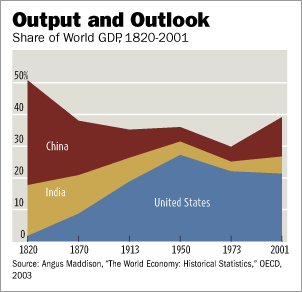
Here is an interesting graphic from the Wall Street Journal, courtesy of Economist Greg Mankiw that shows how large the GDP of the US, China, and India has been relative to the GDP of the entire world.
(Source: Greg Mankiw's Blog)

(Source: Greg Mankiw's Blog)
Monday, September 18, 2006
99 Cent Pricing
This is an age-old question: why do prices in stores end in .99 (like $1.99 instead of $2 or $19.99 instead of $20)?
The traditional explanation is that there is some psychological aspect that makes more people buy the product because it appears much cheaper even though it is only $0.01 cheaper. I buy that to a certain extent, but I feel there is also something to be gained by pricing at even numbers because people appreciate not feeling like they are being tricked. Or why not price items so that they work out to be even numbers when tax is added so that you save people from having to deal with change?
Another explanation I have heard is that it was designed to keep cashiers from pocketing money given to them by customers. Since they are given $1.99 instead of $2, the cashier has to open the register to give change.
Neither of these explanations are really satisfying, so I wanted to see what you guys thought. Another interesting idea is to think about the circumstances where pricing is a little different. Like why are gasoline companies are the only ones to give tenths of a cent on their prices? Or why do some places price in whole numbers (some fancy restaurants, used book stores, concert tickets, etc.) while most do not?
(Schulz gets credit for suggesting the question should be on the blog)
The traditional explanation is that there is some psychological aspect that makes more people buy the product because it appears much cheaper even though it is only $0.01 cheaper. I buy that to a certain extent, but I feel there is also something to be gained by pricing at even numbers because people appreciate not feeling like they are being tricked. Or why not price items so that they work out to be even numbers when tax is added so that you save people from having to deal with change?
Another explanation I have heard is that it was designed to keep cashiers from pocketing money given to them by customers. Since they are given $1.99 instead of $2, the cashier has to open the register to give change.
Neither of these explanations are really satisfying, so I wanted to see what you guys thought. Another interesting idea is to think about the circumstances where pricing is a little different. Like why are gasoline companies are the only ones to give tenths of a cent on their prices? Or why do some places price in whole numbers (some fancy restaurants, used book stores, concert tickets, etc.) while most do not?
(Schulz gets credit for suggesting the question should be on the blog)
No, Really, This Is Our Farewell Tour...
Big-time artists that have been around for awhile will many times announce a farewell tour when they plan to retire from the music business. However, you then see some bands come out of retirement after their so-called farewell, or at least extend the farewell long enough to play cities multiple times (some recent examples are Eric Clapton, Cher, and the Who). In fact, Phil Collins named his tour this summer the "First Final Farewell Tour" as reference to this phenomenon.
Clearly, bands name their tours this because it raises the revenue for the tour because people think they will never have the chance to see this band again. But on the other hand, if bands keep going back on saying it is a farewell tour, then they lose credibility and people won't be as likely to buy a ticket when it is their last tour. What are your thoughts on this whole idea? What would be the revenue-maximizing strategy for a band in this situation? What type of band could use the strategy of announcing a farewell tour? Red Hot Chili Peppers? Death Cab for Cutie? Hilary Duff? U2?
(Question from Austin)
Clearly, bands name their tours this because it raises the revenue for the tour because people think they will never have the chance to see this band again. But on the other hand, if bands keep going back on saying it is a farewell tour, then they lose credibility and people won't be as likely to buy a ticket when it is their last tour. What are your thoughts on this whole idea? What would be the revenue-maximizing strategy for a band in this situation? What type of band could use the strategy of announcing a farewell tour? Red Hot Chili Peppers? Death Cab for Cutie? Hilary Duff? U2?
(Question from Austin)
Friday, September 15, 2006
Reading a Book vs. Watching a DVD
Economist Tyler Cowen offers what I think is a very interesting question:
Another reason I would add:
(Source: Marginal Revolution)
He offers several hypotheses, but the one I find most convincing initially is:I almost always read novels in bits. That is, I put the book down for a few times before finishing it.
I rarely watch movies in bits. That just seems wrong. But, assuming we are watching on DVD, why? Why do pauses ruin a movie but not a book?
2. Most books are longer than most movies, but there is otherwise no good reason for the difference in our consumption pattern.I find this one convincing simply because if there is a book that takes less than two hours to read, I usually read it in one sitting. I tend to think that any movie over 1 hour and 45 minutes is too long, anyway, so I have no problem pausing DVDs and watching the rest later if they are over 2 hours.
Another reason I would add:
- with books, it is easier to look back at an earlier section for a piece of information if your forget, even with the scene selection on DVDs
The ever-wise Natasha notes that we are mostly likely to read action novels -- such as The da Vinci Code -- straight through without pause. But action movies are the easiest to watch in bits. Ever try just a half hour of Jackie Chan? Wonderful. But breaking up a good drama is criminal.What are your thoughts on this?
(Source: Marginal Revolution)
Wednesday, September 13, 2006
Banning Chocolate from Schools
Economist Tim Harford discusses how free markets are suppressed in some cases. The main issue he discusses is how some schools are banning candy in vending machines. The questions to go along with the article are below:
In a few very publicized cases, the government is trying to get directly involved in maintaining (or improving) the health of America's children by putting weight on report cards, removing vending machines from schools, etc. Is it important to do such things, or is it a lost cause? If so, why, and what causes the problem in the first place (like marketing of junk food directly to children)? And is there something, ultimately, that could reduce the incentive for children (and people in general) to eat junk food, or is the approach that these schools are taking (by removing the temptation entirely) the best (or is it an impossible problem to fix at all)?
(Proposed by Nicole)
Divergence Between Test Scores & Economic Performance
Nobel Prize winning Economist Gary Becker has an article posted on the following paradox:
(Source: EconLog)
One of the challenging paradoxes during the past several decades is that American teenagers have consistently performed below average on international tests in math and sciences, and not especially well on reading tests, yet the American economy is more productive than any other.One reason he gives is that the education system in the United States builds up and gets harder as you move up each level, culminating with university, while in some other countries, elementary and secondary school is harder and college is seen as a "break" or a reward for doing all of the work in the first place. I can attest to this phenomenon from observing schools and talking to students in Japan. Another interesting reason he gives that I can relate to as a teacher is that:
American schools are less oriented toward rote teaching than are schools in many other countries, and they are more oriented toward giving students practice in thinking through issues and expressing themselves in discussions.Economist Arnold Kling boils the argument down to two propositions:
Which explanation do you find most convincing? Any other explanations that may be useful?(1) International tests fail to measure the superior aspects of the U.S. education system.
(2) Education is not such an important factor in comparative economic performance.
I lean toward (2). It's better to have strong entrepreneurialism and mediocre education than the other way around.
(Source: EconLog)
Consumer Surplus from Pets
Economist Tyler Cowen has a post on how much consumer surplus people get from pets -- very timely considering what we are studying right now.
He argues that people get a lot of consumer surplus from pets because they value the pets they have very highly, but many families do not want another. Therefore, the willingness to pay for the pet they already have is relative to the price they would have to pay for the next pet (which is determined by their willingness to pay for that next pet).
He goes on in the post to discuss endowment effects and the corresponding rise in living standards, but for this post, let's stick to his idea that people get a lot of consumer surplus out of their pets. Any thoughts in agreement or disagreement?
(Source: Marginal Revolution)
He argues that people get a lot of consumer surplus from pets because they value the pets they have very highly, but many families do not want another. Therefore, the willingness to pay for the pet they already have is relative to the price they would have to pay for the next pet (which is determined by their willingness to pay for that next pet).
He goes on in the post to discuss endowment effects and the corresponding rise in living standards, but for this post, let's stick to his idea that people get a lot of consumer surplus out of their pets. Any thoughts in agreement or disagreement?
(Source: Marginal Revolution)
Tuesday, September 12, 2006
People Sleep Better on a Pile of Money
An interesting study from the Journal of American Epidemiology suggests that the rich sleep more efficiently. People with higher incomes don't sleep for more hours necessarily, but they spend less time trying to get to sleep each night (called sleep latency).
Here is a link to a graphic from the study and where I originally found out about it.
Any ideas on what your income could have to do with your sleep latency?
(Source: Marginal Revolution)
Here is a link to a graphic from the study and where I originally found out about it.
Any ideas on what your income could have to do with your sleep latency?
(Source: Marginal Revolution)
Monday, September 11, 2006
Copyrights for Fashions?
Economist Greg Mankiw points to an article in the Wall Street Journal that explains a way that designers want to stop cheap imitations of their designs:
(Source: Greg Mankiw's Blog)
prominent fashion designers in the U.S. are pushing for federal legislation that would offer three years of copyright-like protection for designs ranging from dresses and shoes to belts and eyeglass frames.What do you think of this idea? Copyrights protect intellectual property and give people more incentive to create new ideas. However, they also create temporary monopolies and drive up the price of the goods in question. Copyrights already cover written material, songs, etc. Do you think copyrights should be extended to fashions?
(Source: Greg Mankiw's Blog)
Using Economics to Put People in Jail
The Economics Focus in this week's issue of The Economist discusses how the "efficient markets hypothesis" is used in legal cases. Again, we are getting a little ahead of ourselves in the curriculum, but the "efficient markets hypothesis," as applied to the stock market, basically says that the price of a stock includes all of the public information relevant to its value. Therefore, the only reason a stock changes price is because of new information.
You can turn the hypothesis around and measure how much impact an event has on the stock price by determining how much the stock went up or down when the news came out about the event. This hypothesis was used in the legal case of a tax accountant named James Olis
(Source: Freakonomics Blog)
You can turn the hypothesis around and measure how much impact an event has on the stock price by determining how much the stock went up or down when the news came out about the event. This hypothesis was used in the legal case of a tax accountant named James Olis
His 24-year sentence stemmed from a calculation of the financial loss caused to investors in Dynegy by Project Alpha, an accounting fraud in which he took part. That financial loss was estimated using the fall in Dynegy's share price on the news that Project Alpha was fraudulent. According to Judge Lake, it was so big that, under sentencing guidelines then in place, Mr Olis had to go to jail for a long time.Any thoughts on the use of this theory to determine damages? The article discusses some of the controversy of using it.
(Source: Freakonomics Blog)
How to Best Target Foreign Aid
Foreign aid to developing nations has typically been used to fund long-term projects like infrastructure (roads, education systems, etc.). An article in Business Week from Edward Miguel says that it should be used instead to repair the short-term effects of natural catastrophes:
(Source: Marginal Revolution)
There is no link to the article, but here is a link to the Marginal Revolution post that cited it and also an opinion from economist Tyler Cowen that his issue is that he does not think the foreign aid would end up in the hands of the poor in these cases.Our research find that a 5% drop in per capita income due to drought increases the likelihod of a civil conflict [in African countries] in the following year by nearly one half. That's a very large effect.
...Currently, most foreign aid focuses on long-term investments in infrastructure of education but does little to deal with such short-term triggers of violence as drought or falling export commodity prices. But our research suggests a larger share of aid should aim to dampen the sharp falls in income that actually generate recruits for rebel movements.
(Source: Marginal Revolution)
Sunday, September 10, 2006
How does YouTube make money?
The Economist has an article about the business model of YouTube. The key question is how the site makes money out of people posting amateur videos (which costs a lot in terms of bandwidth and data storage). The main answer is that they don't really have a way of making money yet. Here are their two ideas right now:
(Source: Newmark's Door)
Aware that inserting advertisements at the beginning of video clips, as some sites do, is annoying and risks driving away YouTube's users, Mr Hurley and Mr Chen have announced two experiments with advertising, with the promise of more to come. One idea is for “brand channels” in which corporate customers create pages for their own promotional clips. Warner Brothers Records, a music label, led the way, setting up a page to promote a new album by Paris Hilton. The second experiment is “participatory video ads”, whereby advertisements can be uploaded and then rated, shared and tagged just like amateur clips. This “encourages engagement and participation,” the company declares.Do you think YouTube is a sustainable business? Any thoughts about their ideas on how to make money? I know that many of you are the prime consumers of YouTube, so would you look at ads in this way?
(Source: Newmark's Door)
Friday, September 08, 2006
Mommy, is Grandma a trucker?
An article in the Wall Street Journal (no link because you need a subscription to read it) by Stephanie Chen describes how trucking companies are trying to hire older couples to drive their big rigs together:
Why do you think trucking companies are facing a shortage of workers? Other than their penchant for driving RVs, why target older couples?Faced with a worsening shortage of long-haul truck drivers, freight carriers are turning to the RV generation, aggressively recruiting older couples like the Fords to climb behind the wheel. Schneider National Inc., the Green Bay, Wis., company that hired the Fords and put them through driving school, fishes for applicants through AARP, the advocacy group for people 50 and older, and has a Web page for "mature workers." This fall, the American Trucking Association plans a billboard and television ad blitz to lure older drivers."We just thought if Ma and Pa can drive the Winnebago, maybe they can drive the 18-wheeler," says Tim Lynch, a senior vice president at the trade group...
The hiring binge has dramatically increased the number of husband-and-wife driving teams, and truck makers are trying to make their big rigs feel more like rolling homes away from home. Paccar Inc.'s Kenworth Truck Co. unit introduced a new model in March with leather beds and heated seats. Volvo Trucks North America, part of AB Volvo, has begun production of trucks with a full-size bed in the cab comfortable for couples.
Thursday, September 07, 2006
Where is it easiest to do business?
The World Bank publishes a report every year called Doing Business that compares different countries and how easy it is to have a business in each country. They look at regulations on the following factors within a country:
1. Singapore
2. New Zealand
3. United States
4. Canada
5. Hong Kong
And the bottom five are as follows:
171. Republic of Congo
172. Chad
173. Guinea-Bissau
174. Timor-Leste
175. Democratic Republic of Congo
Here are some interesting facts from the 2006 report (courtesy of economist Greg Mankiw):
starting a business, dealing with licenses, employing workers, registering property, getting credit, protecting investors, paying taxes, trading across borders, enforcing contracts and closing a business.They then rank countries in on how easy it is to have a business in the country based on the regulations of the government. For 2007, the top five are as follows:
1. Singapore
2. New Zealand
3. United States
4. Canada
5. Hong Kong
And the bottom five are as follows:
171. Republic of Congo
172. Chad
173. Guinea-Bissau
174. Timor-Leste
175. Democratic Republic of Congo
Here are some interesting facts from the 2006 report (courtesy of economist Greg Mankiw):
If you were opening a new business in Lao PDR, the start-up procedures would take 198 days. If you were opening one in Syria, you would have to put up $61,000 in minimum capital—51 times average annual income. If you were building a warehouse in Bosnia and Herzegovina, the fees for utility hook-up and compliance with building regulations would amount to 87 times average income. And if you ran a business in Guatemala, it would take you 1,459 days to resolve a simple dispute in the courts. If you were paying all business taxes in Sierra Leone, they would take 164% of your company’s gross profit...Overall, a clear reason why many countries have difficulty sustaining economic growth is that it is so hard to merely conduct business in the country. Reactions to this? Why do you think so many countries burden their industry with regulations like this?
Wednesday, September 06, 2006
Ethnic restaurants: in the city or suburbs?
In the Washington Post, economist Tyler Cowen, who also publishes a dining guide for the DC area, discusses why some ethnic restaurants are in the suburbs and why others are clustered around ethnic communities. The article references a lot of suburbs of DC, so if you are not familiar with the area, the article loses some impact. However, there are a few interesting points:
First, Cowen argues that ethnic restaurants are moving into the suburbs as rents increase in the city, ethnic populations move into the suburbs, and American tastes welcome the new flavors:
First, Cowen argues that ethnic restaurants are moving into the suburbs as rents increase in the city, ethnic populations move into the suburbs, and American tastes welcome the new flavors:
This new mobility is weakening the whole notion of the ethnic neighborhood. Forget the old Chinatown paradigm: Diffusion is the new model. As a result, ethnic restaurants are more like scattered outposts, drawing from a wide radius. As Serrano points out, "Our competition is not right next door. We compete with . . . restaurants five or 10 miles away."Cowen also discusses, however, the types of restaurants that are still clustered in ethnic neighborhoods. They tend to be ethnic foods, like Korean and Filipino, that do not appeal as much to American tastes.
Filipinos, for example, are the second most numerous Asian group in the United States (some 2 million, compared with 2.7 million Chinese). But outside of Little Manila in Los Angeles and parts of San Francisco, Filipino restaurants are unusual. The Washington area -- where there are some 34,000 people of Filipino heritage -- has Little Quiapo in Arlington and Manila Cafe in Springfield. But few non-Filipino Americans have a love for fish sauce, vinegar marinade and oxtail. And, as my Filipino friend John Nye has told me, many Filipinos prefer a home-cooked meal.
Tuesday, September 05, 2006
Movie Industry in Nigeria
In an article from the July 29th issue of The Economist, the author discusses the emerging film industry in Nigeria (no link because a password is needed to access it). The article discusses how the industry started with one low-budget film in 1992 and ballooned ever since.
Nigeria strikes me as an interesting place to develop a thriving film industry. Any ideas on why Nigeria would develop such an industry (what resources it has that would allow them to develop the industry)? Or how it would grow so large so quickly?
Apparently, the films are mostly straight-to-VHS films, and are watched all over Africa. Furthermore, the industry thrives with little to no help from the Nigerian government."Nollywood, as Nigeria's film industry is known, now makes over 2,000 low-budget films a year, about two-thirds of them in English. That is more than either Hollywood or India's Bollywood.
Today, filmmaking employs about a million people in Nigeria, making it the country's biggest employer after agriculture."
Nigeria strikes me as an interesting place to develop a thriving film industry. Any ideas on why Nigeria would develop such an industry (what resources it has that would allow them to develop the industry)? Or how it would grow so large so quickly?
Press 1 for English, Oprime dos para espanol
A new business called Bringo! has arisen to alleviate the frustrations associated with calling companies' customer service lines. Below is how one of the founders, Marcin Musiolik, describes the company:
(after looking at their site, they don't have a number, address, or email where you can contact them, which would make me nervous if I was giving them my phone number)
(Source: Freakonomics Blog)
"Our mission is to help users skip phone trees and connect with a real human on the customer support phone lines at many companies throughout the U.S. Users simply choose the company they wish to call, and we’ll dial the company directly, navigate their phone tree, and call them back when they are in queue for an operator or customer service representative.”Do you think this is a sustainable business idea? Any thoughts on who their real market would be or who they should market to?
(after looking at their site, they don't have a number, address, or email where you can contact them, which would make me nervous if I was giving them my phone number)
(Source: Freakonomics Blog)
Friday, September 01, 2006
If only Iraq were more "squiggly"...
On Bloomberg.com, Amity Shlaes discusses an article by three economists that looks at how a country's borders determine how successful the country is. They claim that national borders that are determined by natural boundaries (mountains, deserts, rivers) result in a more stable and successful country. Therefore, countries that have boundaries that are arbitrarily determined straight lines are more likely to split up or combine ethnic groups in ways that cause conflict for the country.
They use the word "squiggly" to represent natural boundaries and measure the "squiggly index" to determine how much of a country's border is determined by natural boundaries. In the article, Shlaes claims that Iraq will always face turmoil because their borders were arbitrarily determined (they have a low "squiggly index").
This is just an interesting example of applying data anlysis techniques to questions that push the boundaries of economics.
After reading the article, what do you think of the study? Do you agree with the recommendations of the authors? (Any comments that are too politically-charged or in any way disrespectful of both sides will be deleted)
(Source: Greg Mankiw's Blog)
They use the word "squiggly" to represent natural boundaries and measure the "squiggly index" to determine how much of a country's border is determined by natural boundaries. In the article, Shlaes claims that Iraq will always face turmoil because their borders were arbitrarily determined (they have a low "squiggly index").
This is just an interesting example of applying data anlysis techniques to questions that push the boundaries of economics.
After reading the article, what do you think of the study? Do you agree with the recommendations of the authors? (Any comments that are too politically-charged or in any way disrespectful of both sides will be deleted)
(Source: Greg Mankiw's Blog)
A Unique Tourist Attraction
In a nature park in Hidalgo, Mexico (700 miles from the border), a local tribe runs a tourist attraction that allows people to pay 150 pesos (about $15) to spend the night as an illegal immigrant crossing a mock Rio Grande and running from a mock Border Patrol. The tribe says that they run the enterprise as an educational experience to “build empathy for migrants by putting people in their shoes.”
Here is a full description.
(Source: Marginal Revolution)
Here is a full description.
(Source: Marginal Revolution)
Wednesday, August 30, 2006
Less kids = economic growth?
This may be too early in the year for you guys to talk intelligently about the determinants of economic growth since we have not studied any Macroeconomics, but you can take a stab at it anyway:
On his blog, Economist Tyler Cowen summarizes a debate about whether the strong economic growth that Ireland has been experiencing is due to its "youth dependency ratio" being low. This means that there are less children per each working adult (therefore, there are less children that must be supported). Dr. Cowen explains the reasons why the youth dependency ratio might have an effect on economic growth here.
Also, here is the original article by Malcolm Gladwell in the New Yorker that started the debate, which might give a less techincal explanation and may be a better place to start..
(Source: Marginal Revolution)
On his blog, Economist Tyler Cowen summarizes a debate about whether the strong economic growth that Ireland has been experiencing is due to its "youth dependency ratio" being low. This means that there are less children per each working adult (therefore, there are less children that must be supported). Dr. Cowen explains the reasons why the youth dependency ratio might have an effect on economic growth here.
Also, here is the original article by Malcolm Gladwell in the New Yorker that started the debate, which might give a less techincal explanation and may be a better place to start..
(Source: Marginal Revolution)
Tuesday, August 29, 2006
Economics of Haircuts
Economist Bryan Caplan has posted an interesting question at his blog:
(Source: EconLog)
When is demand for haircuts higher? When short hair is in fashion, or long hair? Or is the relationship more complex?When you talk about demand for haircuts, I think you can talk about two different things: the number of haircuts demanded from professional barbers and stylists or instead the amount of money spent on haircuts from professional barbers and stylists.
(Source: EconLog)
Economics Makes You Fat
There have been a lot of debates recently about why people are so much fatter than they used to be. Well, the answer has a lot to do with the law of demand as you can see by this discussion in the Wall Street Journal by economist Darius Lakdawalla, and it basically boils down to the fact that food is now cheaper and and work nowadays demands less physical activity:
It's no secret that Americans have been getting fatter over the last several decades. But in fact, weight has been rising for more than 150 years, as shown by the economic historians Dora Costa and Richard Steckel. From the Civil War to the 1990s, the weight of a 6-foot-tall American male increased by about 30 pounds on average.
These historical trends are not hard to understand. As we have gotten wealthier and more technologically advanced, food has gotten cheaper and work more sedentary. Both these factors have contributed to rising weight over the time-frame of centuries, and the recent rise in obesity has likewise been fueled by reductions in the price of food.
Since 1976, food has fallen in price by more than 12% compared to other goods. My colleague Tomas Philipson and I have shown that this reduction in price can explain at least half the recent growth in obesity. Shin-Yi Chou, Michael Grossman and Henry Saffer reached similar conclusions about the importance of price. In addition to its overall price, they stressed the increasing availability of food service establishments.
While it is not entirely clear whether restaurants make people heavier, or heavier people attract more restaurants, there is no question that eating is cheaper and easier than it used to be. As if that were not enough, the most calorie-dense foods have seen the biggest price reductions. David Cutler, Edward Glaeser, and Jesse Shapiro have shown that technological advances have especially lowered the price of processed and snack foods -- like french fries and vending machine treats -- which are particularly high in calories.
The evidence above suggests that obesity is a by-product of prosperity and technological advance.
(Source: Greg Mankiw's Blog)
Why it seems like everyone goes to college
A minor detail that I found interesting in the map from the previous post on Starbucks and McDonald's, is that I did not know that KFC and Taco Bell had higher revenues than Starbucks. I expected Starbucks to make more money than either because I know a lot more people that spend a lot of money at Starbucks as opposed to KFC or Taco Bell.
The problem with my logic is an idea called selection bias. This is where you come to the wrong conclusion due to the fact that the sample of people you know or study does not represent the population as a whole. So just because I don't know many people who eat at KFC or Taco Bell, that might just mean that the type of people I know don't eat there as much as the general population.
Another example of this bias is how students at Walker are surprised to find out that only 60% or so of high school students go to college right out of high school. There is a selection bias at work here since almost everyone you know at Walker or other Cobb county schools plan on going to college, but that does not represent the country as a whole. If you went to an inner city public school or lived in a very rural area, that percentage may seem high instead.
Can you think of any other cases where you had a misconception due to selection bias? Or perhaps a common selection bias amongst Walker students or people you know?
The problem with my logic is an idea called selection bias. This is where you come to the wrong conclusion due to the fact that the sample of people you know or study does not represent the population as a whole. So just because I don't know many people who eat at KFC or Taco Bell, that might just mean that the type of people I know don't eat there as much as the general population.
Another example of this bias is how students at Walker are surprised to find out that only 60% or so of high school students go to college right out of high school. There is a selection bias at work here since almost everyone you know at Walker or other Cobb county schools plan on going to college, but that does not represent the country as a whole. If you went to an inner city public school or lived in a very rural area, that percentage may seem high instead.
Can you think of any other cases where you had a misconception due to selection bias? Or perhaps a common selection bias amongst Walker students or people you know?
Monday, August 28, 2006
Starbucks and McDonald's
Here is a map that shows the number of Starbucks and McDonald's outlets in each country around the world. A couple of interesting details is that 3 new Starbucks outlets open daily, and McDonald's has annual sales that double Afghanistan's GDP.
The main question that springs to mind when I see these two graphs is why it is these companies that have such a global reach? Why aren't there as many Burger King and Kentucky Fried Chicken outlets in foreign countries as there are Starbucks?
(Source: Marginal Revolution)
The main question that springs to mind when I see these two graphs is why it is these companies that have such a global reach? Why aren't there as many Burger King and Kentucky Fried Chicken outlets in foreign countries as there are Starbucks?
(Source: Marginal Revolution)
Thursday, August 24, 2006
Why Don't People Buy More CD Box Sets?
Economist Tyler Cowen of Marginal Revolution has a post talking about CD box sets and why people do not buy many of them (they buy the individual CDs over time instead):
There is also the other issue where people buy huge packages of stuff at Costco and Sam’s Club when they most likely won’t use the whole box. Maybe because there is no “anticipatory pleasure” from buying lots of small packages of granola bars and socks (or at least not enough to outweigh the cost savings).
There is a neuroeconomics critique of Big Box Sets. So much of the pleasure of a purchase lies in the anticipation of the buy rather than the having. The anticipatory pleasure of a Big Box Set, no matter how large, is not so much greater than the anticipatory pleasure from a single CD. Yet once you own a large box it sits around. You can't listen to the CDs all at once. They start to feel "stale," and then you go out and want that anticipatory fix again. Bryan Caplan aside, the anticipatory pleasure of "listening to the seventh CD in the box" is somehow not the same.Are there any other examples of this phenomenon where you buy smaller packages to get more enjoyment out of actually buying them?
There is also the other issue where people buy huge packages of stuff at Costco and Sam’s Club when they most likely won’t use the whole box. Maybe because there is no “anticipatory pleasure” from buying lots of small packages of granola bars and socks (or at least not enough to outweigh the cost savings).
Sunday, August 20, 2006
Voting Lotteries
Related to the last post on voter turnout, Arizona is considering a $1 million lottery program to increase voter turnout. Basically, if you vote in Arizona, you have one lottery ticket to a possible grand prize of $1 million dollars.
This program goes right along with our current discussion of incentives and voter turnout. What do you guys think of this program? Is it a good idea? How much of an effect do you think it will have?
I think an even more interesting question is: will this program change the demographics of the people voting in Arizona?
(Source: Volokh Conspiracy)
This program goes right along with our current discussion of incentives and voter turnout. What do you guys think of this program? Is it a good idea? How much of an effect do you think it will have?
I think an even more interesting question is: will this program change the demographics of the people voting in Arizona?
(Source: Volokh Conspiracy)
Which is worse: not voting or not knowing anything about the candidates?
Last week in class, we explained why so many people don't vote or don't know anything about the candidates because of rational ignorance. Basically, the probability that one vote will have any affect on an election means that many people think their time is more valuably spent on other activities.
Law Professor Ilya Somin has an interesting blog post about whether we should be concerned about low voter turnout (which was about 59% in the last Presidential election). He argues voter turnout is not low enough to be really concerned about and that the bigger problem is that most people don't know anything about the candidates they are voting for or against. (Read the post for his specific arguments)
What do you guys think is the bigger problem here? Should we be more concerned with the fact that only 60% of the country votes in the Presidential elections and even less vote in local elections? Or should we be more concerned about getting those people who do vote to be more educated on the candidates or issues they are voting on?
(Source: Cato @ Liberty)
Law Professor Ilya Somin has an interesting blog post about whether we should be concerned about low voter turnout (which was about 59% in the last Presidential election). He argues voter turnout is not low enough to be really concerned about and that the bigger problem is that most people don't know anything about the candidates they are voting for or against. (Read the post for his specific arguments)
What do you guys think is the bigger problem here? Should we be more concerned with the fact that only 60% of the country votes in the Presidential elections and even less vote in local elections? Or should we be more concerned about getting those people who do vote to be more educated on the candidates or issues they are voting on?
(Source: Cato @ Liberty)
Sunday, August 13, 2006
Blog is Back with Waterparks
The Walker Economics Blog is back for a new school year, and the theme of the first week of the course is the wide reach of Economics: in other words, how many topics there are that are studied or written about by economists that are not normally considered to be part of the subject.
In honor of that theme, here is a link to a blog run by Steven Levitt, the author of Freakonomics, where he wonders why there are so many water parks in Wisconsin Dells, Wisconsin. In fact, the Wisconsin Dells Visitor's Bureau lists 6 large waterparks in the city and calls Wisconsin Dells "the Waterpark Capital of the World."
Any ideas of why they would put so many waterparks in one city in the middle of central Wisconsin? Why aren't there 6 waterparks in a random city in a warm state like Florida or Texas instead? Why not have 6 waterparks in Orlando or Las Vegas where you have millions of tourists every year?
(Feel free to discuss the validity of the answers offered by commenters on the Freakonomics blog.)
In honor of that theme, here is a link to a blog run by Steven Levitt, the author of Freakonomics, where he wonders why there are so many water parks in Wisconsin Dells, Wisconsin. In fact, the Wisconsin Dells Visitor's Bureau lists 6 large waterparks in the city and calls Wisconsin Dells "the Waterpark Capital of the World."
Any ideas of why they would put so many waterparks in one city in the middle of central Wisconsin? Why aren't there 6 waterparks in a random city in a warm state like Florida or Texas instead? Why not have 6 waterparks in Orlando or Las Vegas where you have millions of tourists every year?
(Feel free to discuss the validity of the answers offered by commenters on the Freakonomics blog.)
Thursday, May 18, 2006
See You in August
As an FYI, this blog will not see any new posts for awhile due to AP exams and the summer. The blog will pick up in August again when my next AP Microeconomics class begins.
For any of my students who read this, you can continue to be updated with thoughtful, interesting applications of economics by visiting Marginal Revolution, Freakonomics blog, or Greg Mankiw's blog, among others.
For any of my students who read this, you can continue to be updated with thoughtful, interesting applications of economics by visiting Marginal Revolution, Freakonomics blog, or Greg Mankiw's blog, among others.
Wednesday, March 15, 2006
Evidence of Point Shaving in College Basketball
Since the NCAA tournament starts tomorrow (I don't really count the play-in game), here is a college basketball related story:
An economist at Penn argues that point shaving occurs in 5% of games with large spreads. The interesting part is how he examines the data for clues that this is happening. It is very similar to the chapter on cheating teachers in Freakonomics.
(Source: Freakonomics Blog)
An economist at Penn argues that point shaving occurs in 5% of games with large spreads. The interesting part is how he examines the data for clues that this is happening. It is very similar to the chapter on cheating teachers in Freakonomics.
(Source: Freakonomics Blog)
Tuesday, March 14, 2006
The $39 Experiment
This site describes an experiment where a guy mailed letters to various companies asking for free stuff. He keeps updates on who gives him rejections and who sends him free stuff. Some of the letters are fairly entertaining:
To McDonalds:
(Source: Marginal Revolution)
To McDonalds:
To Nylabone:Dear Sir or Madam:
You may love to see me smile, but I, however, love to see me eat. Please send me coupons for free McDonald's product, so that I may continue to eat (and smile).
Thank you well in advance, Tom Locke, eating enthusiast
Dear Sir or Madam:He has already gotten more responses than I thought he would. Any predictions for what type of companies are likely to give him free stuff? Any explanation for the type of companies who already have? If you had to pick another company that he did not choose that you think would be very likely to send you free stuff if you asked, which would you choose?
My dog (a random mutt) loves your "Healthy Edibles" bones. I wanted to name the dog "Bonecrusher", but my wife ended up naming him "Rudy Huxtable". What a stupid name for a dog. Anyway, your bones are the only thing that stops this dog from molesting my leg while I'm working on the computer. Any chance you could send over some free samples? My dog – and my leg – would greatly appreciate it! Thanks well in advance, Tom Locke, "keeping my dog off of my leg" enthusiast
(Source: Marginal Revolution)
Are DVDs the death of movie theaters?
There has been a lot of talk about how movie theaters are in big trouble due to the fact that people buy a lot of DVDs nowadays, can watch recorded TV shows on their TiVo or DVR, and can watch all of these media forms on big plasma TVs that are close to theater experience anyway.
Here is an interview in the NY Times with the CEO of Regal where he explains why he thinks DVDs are good for the movie theater business. Here is his response to the question of how much of a threat DVDs are to movie theaters:
(Source: Marginal Revolution)
Here is an interview in the NY Times with the CEO of Regal where he explains why he thinks DVDs are good for the movie theater business. Here is his response to the question of how much of a threat DVDs are to movie theaters:
Which side do you believe? The side saying that movie theaters are on their way out or the side saying that movie theaters are helped by the popularity of DVDs, etc.?I think DVD's have been the savior of not only the studio model but have been beneficial to theater owners, too, because it funnels more money back into the studios, which in turn fuels higher production budgets, greater numbers of films, and so on.
We have seen the window shrink from an average of about six months between theatrical to video 10 years ago to about four and a half months today. Some compression of that window over time is justified, or has been justified at least in the past, because we generate our piece of the pie at the box office much quicker today than we did a decade ago.
People who run the studios are smart people, and I think they realize the tremendous value of having that theatrical launch pad. And I don't think that's going to change. They make films to be released on the big screen.
(Source: Marginal Revolution)
Monday, March 13, 2006
Car-buying in China
Another China Fact of the Day courtesy of Business Week via Marginal Revolution:
84 percent of new car sales in China are to first-time buyers. In the U.S., just 1 percent are.
What does this tell us about China? If you were starting a business in China, what type of business would you start (other than a car company)?
Friday, March 03, 2006
Wind Power Off Cape Cod
This article posted on the Environmental and Urban Economics Blog discusses a project to build a "wind farm" to provide 3/4 of the power to the Cape Cod area of Massachusetts. However, the efforts are currently being blocked by a group of residents called the Alliance to Protect Nantucket Sound. The author states that the Coase theorem should be applicable here.
How could the Coase theorem be used in this case? Any guesses at what the efficient solution may look like?
How could the Coase theorem be used in this case? Any guesses at what the efficient solution may look like?
Wal-Mart Lawsuit
A post on Division of Labour discusses an unusual lawsuit that has been filed against Wal-Mart (the original article is from the Detroit News):
Why would forcing companies to list prices result in higher prices at the stores?
Also, explain what the author means when he says that the Michigan law is "most likely a make-work sop to unionists"?
(Source: Division of Labour)
"LANSING -- State Attorney General Mike Cox said Wednesday he is taking legal action against Wal-Mart after an investigation at five of the retailer's stores found up to 80 percent of the merchandise didn't carry price tags."
Nearly 100% of the merchandise in my local Wal-Mart doesn't have price tags so what's the rub? Michigan has an item pricing law mandating that merchandise have old-fashioned price tags. So-called consumer advocates bleat about mispricing from scanners and barcodes, but the law is most likely a make-work sop to unionists. The Michigan AG is now using the law to beat up Wal-Mart--I'd bet dollars to donuts that it's either outright false or a case of selective enforcement.
BTW, Emory's Paul Rubin has a paper (with co-authors) examining the effects of item pricing laws. The money line:"We find consistent evidence across products, product categories, stores, chains, states, and sampling periods, that the prices at stores facing item-pricing laws are higher than the prices at stores not facing the item-pricing laws by about 25 cents or 9.6% per item."
Why would forcing companies to list prices result in higher prices at the stores?
Also, explain what the author means when he says that the Michigan law is "most likely a make-work sop to unionists"?
(Source: Division of Labour)
Thursday, February 09, 2006
Valentine's Day Economics
To stay with the same theme, what about interesting economic effects of Valentine's Day?
Stay away from the obvious: increased demand for flowers and chocolates, etc. The more creative the economic effect, the better.
Stay away from the obvious: increased demand for flowers and chocolates, etc. The more creative the economic effect, the better.
Groundhog Day
So last week was Groundhog Day, which of course only reminds me of the Bill Murray movie from awhile back where he wakes up and every day is the same -- he keeps reliving Groundhog Day over and over again.
So to throw out an irrelevant, abstract though experiment, what do you think the economic effects would be if the world was stuck in a Groundhog Day (instead of just the Bill Murray character in the movie)? Keep in mind that everything resets when you wake up the morning to exactly what it was like when you woke up the day before.
So to throw out an irrelevant, abstract though experiment, what do you think the economic effects would be if the world was stuck in a Groundhog Day (instead of just the Bill Murray character in the movie)? Keep in mind that everything resets when you wake up the morning to exactly what it was like when you woke up the day before.
You're so ugly it's criminal
A new paper from the National Bureau of Economic Research finds that, controlling for other factors, people that are ugly are more likely to commit crimes. The paper is called, simply enough, "Ugly Criminals," and below is the abstract:
Any ideas of why this might be? Remember that the authors establish that it is not because rich people are less likely to be ugly.
(Source: Marginal Revolution)
Using data from three waves of Add Health we find that being very attractive reduces a young adult's (ages 18-26) propensity for criminal activity and being unattractive increases it for a number of crimes, ranging from burglary to selling drugs. A variety of tests demonstrate that this result is not because beauty is acting as a proxy for socio-economic status. Being very attractive is also positively associated adult vocabulary test scores, which suggests the possibility that beauty may have an impact on human capital formation. We demonstrate that, especially for females, holding constant current beauty, high school beauty (pre-labor market beauty) has a separate impact on crime, and that high school beauty is correlated with variables that gauge various aspects of high school experience, such as GPA, suspension or having being expelled from school, and problems with teachers. These results suggest two handicaps faced by unattractive individuals. First, a labor market penalty provides a direct incentive for unattractive individuals toward criminal activity. Second, the level of beauty in high school has an effect on criminal propensity 7-8 years later, which seems to be due to the impact of the level of beauty in high school on human capital formation, although this second avenue seems to be effective for females only.And yes, this is economics.
Any ideas of why this might be? Remember that the authors establish that it is not because rich people are less likely to be ugly.
(Source: Marginal Revolution)
Wednesday, February 08, 2006
The Nuclear Threat of Iran
A current issue in the news is the concern over the nuclear program in Iran. There are fears that if Iran obtains (or seriously attempts to obtain) nuclear weapons the situation would become a new Iraq or that the nuclear technology would be given to terrorists by the Iranians or that Iran would use the nuclear weapons on the US or Israel.
This issue of course has relevance to economics through the application of game theory. This first article is a post by Tyler Cowen that discusses his relative optimism that nuclear weapons would not be used if obtained by Iran. This article is by Thomas Schelling, who as you remember, won this past year's Nobel prize in part for his work on the application of game theory to nuclear deterrence. Each article remains optimistic about the situation using past evidence of nuclear weapons not being used, particularly with Israel, India, and Pakistan.
Both articles are very interesting and give a further example of the application of economic thinking to current important problems.
This issue of course has relevance to economics through the application of game theory. This first article is a post by Tyler Cowen that discusses his relative optimism that nuclear weapons would not be used if obtained by Iran. This article is by Thomas Schelling, who as you remember, won this past year's Nobel prize in part for his work on the application of game theory to nuclear deterrence. Each article remains optimistic about the situation using past evidence of nuclear weapons not being used, particularly with Israel, India, and Pakistan.
Both articles are very interesting and give a further example of the application of economic thinking to current important problems.
Monday, February 06, 2006
Controversial Foreign Aid
From an economics blog called SmartEconomist.com:
I imagine this article will garner some divided views from you guys, so what do you think? Is cultural pride interfering with social welfare or is it worth sacrificing a relatively small amount of food to maintain the dignity of their people?
(Source: Marginal Revolution)
In Kenya, four million people are facing hunger due to severe drought. A New Zealand dog food manufacturer offered to donate 6,000 emergency packs of dog food mixture to help feed Kenyan orphans. A Kenyan government spokesman said: "We appreciate the offer, but we dismiss it as culturally insulting."Their source is the following BBC article.
I imagine this article will garner some divided views from you guys, so what do you think? Is cultural pride interfering with social welfare or is it worth sacrificing a relatively small amount of food to maintain the dignity of their people?
(Source: Marginal Revolution)
Subscribe to:
Posts (Atom)