The announcement was really about a week ago, but I have not gotten around to posting about this until now. Edmund Phelps is a macroeconomist, so his accomplishments will not mean as much until next semester.
His main contribution is the idea of a natural rate of unemployment, which is a certain level of unemployment that will exist even when the economy is functioning at its potential. He also wrote about the importance of inflationary expectations -- the fact that it matters what people think inflation is going to be in the future.
Phelps is honestly not an economist whose work I know very well, but here is the press release announcing what he got the award for, and here is a summary of his accomplishments by economist Tyler Cowen.
Wednesday, October 18, 2006


Tuesday, October 17, 2006
Optimal Charitable Giving Strategies
Tim Harford has an article in Slate that talks about the economics of charitable giving. The part that I think is most interesting is when he argues that we should give only to one cause to maximize the effectiveness of our charitable giving. Here is his explanation:
(Source: Marginal Revolution)
Economist Tyler Cowen discusses this article and gives another argument for giving to only one charity:Even the way we choose to dole out cash betrays our true motives. Someone with $100 to give away and a world full of worthy causes should choose the worthiest and write the check. We don't. Instead, we give $5 for a LiveStrong bracelet, pledge $25 to Save the Children, another $25 to AIDS research, and so on. But $25 is not going to find a cure for AIDS. Either it's the best cause and deserves the entire $100, or it's not and some other cause does. The scattershot approach simply proves that we're more interested in feeling good than doing good.
Many people are unconvinced by this argument—which I owe to Steven Landsburg—because they are used to diversifying their financial investments (a bit of Google stock and a bit of Exxon, too) and varying their choices (vanilla ice cream AND bananas). But those instincts are selfish: They are not intended to benefit both Google and Exxon, nor both the ice-cream company and the banana growers. With charity, the logic is different, and a truly selfless donor would bite the bullet and put his entire donation behind one cause. That we find that so hard to imagine is just one more indication of how hard it is for us to think ourselves into a truly selfless view of the world.
None of this is to say that these contributions are worthless or economically insignificant. Just don't get too starry-eyed about the motives behind them.
I agree with Harford's point in a different regard. The fixed costs of processing a donation are relatively high, if only because the charity will send further letters asking for more money. For that reason it may be better to focus our giving on a single charity.What do you think? If you had $1,000 to give, what strategy would yield the biggest impact?
(Source: Marginal Revolution)
Doggie Ice Cream
Good Humour is going to start making ice cream sandwiches for dogs.
(Source: Marginal Revolution)
Why do you think there would be a market for this? You could also argue why there will not be a market for this (or why no one will buy it as long as they have that horrendous slogan).Companies appear to be on a never-ending quest for ways to pamper your pooch, and here's the latest evidence: Ice cream maker Good Humor and pet food producer Pedigree have announced plans to produce ice cream sandwiches for dogs.
Apparently this is not a stupid pet snack. The companies said they needed a special formula for the dairy treats, as many dogs are lactose intolerant and cannot easily digest regular ice cream. Pedigree Ice Cream Sandwich Treats for Dogs will be dairy-based and have the same texture as ice cream, but contain only 1 percent lactose. The treats also will have added protein and no sugar, and are "pawsitively delicious," the firms' press release exclaims. A package containing 6 frozen yummies will
sell for $3.99.
(Source: Marginal Revolution)
Thursday, October 12, 2006
Rising Prices of Cancer Drugs
The NY Times this week has an article about the skyrocketing prices of cancer treatment drugs. They profile a new drug called Abraxane that costs $4,200 per dose, and is considered to be only a marginal improvement (if at all) over the older, much cheaper drug. The article also highlights the reasons why the prices of cancer drugs are increasing so much:
The rise in cancer-drug prices is a microcosm of broader trends pushing up health care costs nationally. Despite decades of efforts by governments and insurers to restrain costs, patients continue to want the newest — and most expensive — drugs and medical devices. And doctors and the health care industry have little reason to keep costs in check, because insurers rarely deny coverage for new treatments on the basis of price.And the insurance companies are not the only ones that face the higher price:
Drug industry experts say Abraxane’s price reflects the fact that makers of cancer drugs can charge high prices for new medicines even if they are only marginally better than their older counterparts. That pricing dynamic is enabled by insurance, which shields patients from the full price of drugs. Without pressure from their insurers, patients have little reason to choose older treatments over expensive new therapies.
Even if they have insurance, many patients face co-payments of 20 percent for their cancer drugs, an expense that can become ruinous for patients receiving combination therapy with several new drugs. For example, Abraxane is being tested along with Avastin, a treatment from Genentech that costs $8,000 a month for some patients.Here are some questions that go along with the article from Sarah:
Drug costs are rising so fast that some patients cannot afford the newest treatments, and access to some therapies “is beginning to be eroded,” Ms. Hinestrosa said.
What are the problems of this current system and what can be done to limit the prices of these not even miracle drugs? What are the long term effects of this trend and is it caused only by increased demand by consumers?(Question posed by Sarah O.)
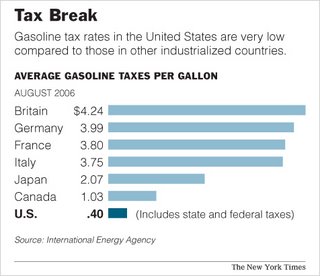
World Gasoline Taxes
Below is a graph showing the taxes on gasoline in industrialized countries from the NY Times this week:
 (Source: Greg Mankiw's Blog)
 (Source: Greg Mankiw's Blog)
Netflix $1 Million Contest
Netflix is offering $1 million to anyone who can beat their movie recommendation system, which recommends movies based on whether people liked or disliked other movies. They have a dataset of anonymous movie ratings, and your system would have to predict what movies people will like at least 10% better than the system that Netflix currently uses.
Here is an overview of the basic rules. You can look at how the teams competing for the prize are doing here.
Here is the take of Economist Steven Levitt:
If you do agree that it is a brilliant strategy, why don't more companies use this method of innovating?
(Source: Freakonomics Blog)
Here is an overview of the basic rules. You can look at how the teams competing for the prize are doing here.
Here is the take of Economist Steven Levitt:
I love the Netflix approach to the problem. They could easily spend $1 million internally hiring some programmers or Ph.D’s to try to improve their algorithm, with uncertain results. Instead, by making it a contest and offering up data to outsiders, they will probably succeed in having 100 times as many person-hours devoted to the problem for the same price—or cheaper because they only pay out the million if someone really improves on what they are doing now. In addition they gets lots of free publicity. Truly a brilliant strategy.Do you agree that it is a brilliant strategy? Is there any downside to this strategy?
If you do agree that it is a brilliant strategy, why don't more companies use this method of innovating?
(Source: Freakonomics Blog)
Another Downside to Quantity Restrictions on Organs
Economist Alex Tabarrok discusses a further danger of the ban on organ sales: lack of experience in transplants. He argues that due to the shortage of organs, many hospitals only do a few transaplants a year and therefore are more likely to make mistakes due to the inexperience and lack of practice.
This post is timely since you guys did a paper on the possibility of the organ market just a few weeks ago and adds an argument that I had not heard before.
(Source: Marginal Revolution)
Medicare requires that transplant centers perform 12 transplants a year to be certified but many programs are in violation of that standard with little consequence. Medicare is even thinking of reducing the standard from 12 per year to 9 in 30 months. As one specialist says "I wouldn't take my car to be serviced by someone who repaired nine cars over the past three years. Would anyone do that?"He references an article and graph in the Washington Post that discusses the fact that many hospitals are currently falling short of this mark.
This post is timely since you guys did a paper on the possibility of the organ market just a few weeks ago and adds an argument that I had not heard before.
(Source: Marginal Revolution)
7-11 and the White Sox
The Chicago White Sox and the convenience store chain of 7-11 struck a marketing deal where the start time of all White Sox home games for the next 3 years will be 7:11pm. The deal will pay $500,000 a year to the team.
This is a creative advertising strategy and a way to create value and exchange from a starting time where there was not value being traded before. Do you think it will be worth it for both groups? Is this a good business decision for both sides?
This is a creative advertising strategy and a way to create value and exchange from a starting time where there was not value being traded before. Do you think it will be worth it for both groups? Is this a good business decision for both sides?
Friday, October 06, 2006
How to Allocate Flu Vaccines?
In the Wall Street Journal today, there is an article that discusses the important, but tricky question of how limited vaccines should be allocated in the event of a national emergency. The question is relevant due to concerns that have arisen over the past few years over the avian flu.
The author of the article, Sharon Begley, reports on a paper that questions the conventional wisdom on the issue:
This is a pretty controversial question, so I urge you to read the whole article before commenting and to keep the comments civil and well thought-out.
(Source: Greg Mankiw's Blog)
The author of the article, Sharon Begley, reports on a paper that questions the conventional wisdom on the issue:
What do you guys think? If you only have a certain number of vaccines, who should get first priority?In May, scientists at the National Institutes of Health stirred things up with a paper calling into question the policy that aims to save the most lives by first vaccinating the old, the very young and the sick, putting last those who are two to 64 years of age.
The value of a life, they argued, depends on age. A 60-year-old has invested a lot (measured by education and experience) in his life, but has also reaped most of the returns. A child has minimal investment. A 20-year-old has great investment but has reaped almost none of the returns. Conclusion: To maximize investment in a life plus years of life left, 13- to 40-year-olds should have first claim on rationed vaccine, explains NIH's Ezekiel Emanuel.
This is a pretty controversial question, so I urge you to read the whole article before commenting and to keep the comments civil and well thought-out.
(Source: Greg Mankiw's Blog)
What type of economist should get the Nobel Prize?
I know that I have been posting about nothing but the Nobel Prize this past week, so you guys might be tired of it, but has been a convenient way to introduce you to the work of current economists.
Economist Greg Mankiw has an interesting question posted on his blog about what type of economist tends to get the Nobel Prize. He states that
Economist Greg Mankiw has an interesting question posted on his blog about what type of economist tends to get the Nobel Prize. He states that
What do you guys think? Should they be giving Nobel Prizes to the economists that come up with a few pathbreaking ideas (the home run hitters)? Or to economists that have larger quantities of consistent, solid research (the batting average leaders)? Which would be better for the field of economics? Which would be better for society as a whole in terms of advancing knowledge and having better economic policies?There was an apparent consensus that the Nobel committee prefers rewarding people for a few path-breaking works, rather than judging an entire career of contributions. Is this optimal?
If the goal is to provide researchers with the right incentives, it may not be. It is as if a baseball team paid players based only on the number of home runs. We would have too many players swinging for the bleachers and too few base hits. In economics, maybe we get too many of the best people trying to create new paradigms and too few engaged in more routine, applied research.
Ig Nobel Prizes
Since we have been discussing the impending Nobel Prizes, the "Ig Nobel" Prizes are also given out each year, and they are a lot less prestigious, but also a lot more entertaining. They are given out for research that is unusual and/or humorous, and as I quoted last year on this blog, for research that "cannot or should not be reproduced."
A list of this year's winners are listed here.
A couple of the more unusual ones:
A list of this year's winners are listed here.
A couple of the more unusual ones:
ORNITHOLOGY: Ivan R. Schwab, of the University of California Davis, and the late Philip R.A. May of the University of California Los Angeles, for exploring and explaining why woodpeckers don't get headaches.
CHEMISTRY: Antonio Mulet, José Javier Benedito and José Bon of the University of Valencia, Spain, and Carmen Rosselló of the University of Illes Balears, in Palma de Mallorca, Spain, for their study "Ultrasonic Velocity in Cheddar Cheese as Affected by Temperature."
Wednesday, October 04, 2006
Nobel Series: William Baumol
William Baumol is an economist at NYU and was the co-author of the intro textbook that I used in college. The main theory of his that I am familiar with and would like to highlight is called "Baumol's cost disease," which sounds more gruesome than it is.
Basically, Baumol's cost disease explains why productivity grows so fast in some sectors while it lags behind in others. In particular, the term refers to the fact that it is difficult to increase productivity in labor-intensive industries, like the arts or education. To use an example from Baumol himself, it takes the same amount of musicians to play a string quartet as it did 300 years ago. Or to use an example from education, the number of students that can be taught by one teacher is the same as it was 50 years ago. In fact, it may even be less now since there is more of a focus on low student-teacher ratios.
Therefore, while other industries like manufacturing clothing and printing books become more productive due to technological innovation, service industries do not due to the fact that they are labor-intensive goods. Therefore, the costs to produce those service goods remains higher than other goods. This could be an explanation for why the prices of medical care and tuition have been increasing so much while the prices of computers and most other manufactures have been decreasing or increasing at a slower rate.
Here is an article from The New Yorker that discusses the application of Baumol's cost disease further and references a newer study that confirms these ideas.
Can you think of any other examples of industries or goods and services that suffer from Baumol's cost disease?
Basically, Baumol's cost disease explains why productivity grows so fast in some sectors while it lags behind in others. In particular, the term refers to the fact that it is difficult to increase productivity in labor-intensive industries, like the arts or education. To use an example from Baumol himself, it takes the same amount of musicians to play a string quartet as it did 300 years ago. Or to use an example from education, the number of students that can be taught by one teacher is the same as it was 50 years ago. In fact, it may even be less now since there is more of a focus on low student-teacher ratios.
Therefore, while other industries like manufacturing clothing and printing books become more productive due to technological innovation, service industries do not due to the fact that they are labor-intensive goods. Therefore, the costs to produce those service goods remains higher than other goods. This could be an explanation for why the prices of medical care and tuition have been increasing so much while the prices of computers and most other manufactures have been decreasing or increasing at a slower rate.
Here is an article from The New Yorker that discusses the application of Baumol's cost disease further and references a newer study that confirms these ideas.
Can you think of any other examples of industries or goods and services that suffer from Baumol's cost disease?
Tuesday, October 03, 2006
Nobel Series: Gordon Tullock
Another economist who has been discussed as a possible Nobel winner is Gordon Tullock. Dr. Tullock is known for his work in public choice economics (which basically applies economic logic to how government makes decisions). He is mostly known for introducing the idea of "rent-seeking behavior."
Rent-seeking behavior is where an individual or business seeks to gain by changing the economic environment instead of through a productive activity. To make the idea more clear, here are some examples:
Rent-seeking behavior is where an individual or business seeks to gain by changing the economic environment instead of through a productive activity. To make the idea more clear, here are some examples:
- A group of businesses join together to form a cartel and agree to raise prices.
- An industry pays lobbyists to get Congress to pass a bill giving subsidies to the industry.
- One country invades another to take natural resources, like oil.
- A union tries to negotiate higher wages without increases in productivity.
- Any type of theft of property.
The basic idea in all of the examples is that the action is not adding to the total welfare to society, merely providing more profit or resources to the rent seekers (many times just transferring resources from one group to another).
As a sidenote, one of his colleagues at George Mason University posted this about how Tullock always comes up with great insults. Here is my favorite:
The other day Gordon asked me to read one of his papers and Ipointed out a few typos. "Excellent," he said, "this will surely be your greatest contribution to economics."
Can you think of any other examples of rent-seeking behavior? Any ways in which you try to gain without providing any productivity?
Monday, October 02, 2006
Nobel Series: Oliver Williamson, part 2
Williamson's work in transaction cost economics sheds light on the question of what determines the length of a contract. For instance, why is my contract with The Walker School a 1-year contract? Why do some companies give contracts of 3 to 5 years (informally through a trial period)? Why do temp agencies have people whose job is to work for contracts of as little as a day or a few hours?
Part of the reason comes down to the type of investments involved in the transactions. The basic conclusion is that the more "relationship-specific" the investments, the longer the length of the contract. As an example, job-training can be looked at as an investment from both the employer and the employee side. In situations where the employer has to spend a lot of time training employees in skills that are very specific to their company (like a technical job where the software is company-specific), we would expect to see longer contracts. Whereas, in a temp agency where the only training involved is in office skills that can be used in any job (therefore, not very relationship-specific), the contracts can be very short.
An interesting article in Financial Times by economist Tim Harford talks about this very issue. He discusses marriage as a unique long-term contract and how it relates to corporate examples of contract length and relationship-specific investments.
Any other examples of "long-term contracts" that you know of that might have to do with how specific the investments involved are? Reactions to the Harford article?
Part of the reason comes down to the type of investments involved in the transactions. The basic conclusion is that the more "relationship-specific" the investments, the longer the length of the contract. As an example, job-training can be looked at as an investment from both the employer and the employee side. In situations where the employer has to spend a lot of time training employees in skills that are very specific to their company (like a technical job where the software is company-specific), we would expect to see longer contracts. Whereas, in a temp agency where the only training involved is in office skills that can be used in any job (therefore, not very relationship-specific), the contracts can be very short.
An interesting article in Financial Times by economist Tim Harford talks about this very issue. He discusses marriage as a unique long-term contract and how it relates to corporate examples of contract length and relationship-specific investments.
Any other examples of "long-term contracts" that you know of that might have to do with how specific the investments involved are? Reactions to the Harford article?
Nobel Series: Oliver Williamson, part 1
The first possible Nobel economist that I will profile is Oliver Williamson, the one whose work I am most familiar with from graduate school.
He is the economist most responsible for the field of transaction cost economics. Transaction costs are the costs of an economic exchange. As an example, if you decide to buy a car, the price of the car is one of many costs you have to incur. You also have to research to find what kind of car you want, spend time driving to dealerships or looking through classifieds to find the car you want, and finally spend time negotiating on the price or terms of the deal. All of these are transaction costs. These type of costs are many times ignored in the theoretical realm of economic models, but Williamson brought attention to their effect.
Here is a review of one of Williamson's better known works by a UCLA law professor. He adds this assertion on Williamson and transaction costs:
He is the economist most responsible for the field of transaction cost economics. Transaction costs are the costs of an economic exchange. As an example, if you decide to buy a car, the price of the car is one of many costs you have to incur. You also have to research to find what kind of car you want, spend time driving to dealerships or looking through classifieds to find the car you want, and finally spend time negotiating on the price or terms of the deal. All of these are transaction costs. These type of costs are many times ignored in the theoretical realm of economic models, but Williamson brought attention to their effect.
Here is a review of one of Williamson's better known works by a UCLA law professor. He adds this assertion on Williamson and transaction costs:
Williamson's core idea is the theory of transaction cost economics. We can analogize transaction costs to friction: they are dead weight losses that reduce efficiency. They make transactions more costly and less likely to occur. Among the most important sources of transaction costs is the limited cognitive power of human decisionmakers.
Can you think of any other examples where transaction costs are important other than when buying cars? Are there cases where transaction costs can cause you to not make a purchase that you would make if they did not exist?
Sunday, October 01, 2006
Economics of Tipping
Stephen Dubner, co-author of the bestseller Freakonomics, asks why people do not tip flight attendants. He basically argues that flight attendants do the same type of service that you find in a lot of other jobs where the workers do receive tips (waiting tables, hotel bellmen, etc.). Any ideas on why people do not tip flight attendants? What makes it different from those other service jobs?
I think the rules about tipping are generally interesting/confusing. For instance, why is the tip in restaurants based on the value of the meal instead of the number of people at the table? I would think that the number of people at the table has a bigger impact on the amount of work a waiter (or waitress) has to do.
Also, if a tip is supposed to be a reward for a good job of service, why not have a convention where half of the tip is given at the beginning of the meal and half at the end? This strategy might encourage better service since I doubt giving a big tip encourages better service unless you go to a restaurant often enough for the server to recognize you and that you tip well.
Also, here is a link to a post I had last year on economic research on small ways that a server can increase the size of their tips.
(Source: Freakonomics)
I think the rules about tipping are generally interesting/confusing. For instance, why is the tip in restaurants based on the value of the meal instead of the number of people at the table? I would think that the number of people at the table has a bigger impact on the amount of work a waiter (or waitress) has to do.
Also, if a tip is supposed to be a reward for a good job of service, why not have a convention where half of the tip is given at the beginning of the meal and half at the end? This strategy might encourage better service since I doubt giving a big tip encourages better service unless you go to a restaurant often enough for the server to recognize you and that you tip well.
Also, here is a link to a post I had last year on economic research on small ways that a server can increase the size of their tips.
(Source: Freakonomics)
Thursday, September 28, 2006
Nobel Prize Possibilities
The Nobel Prize for Economics is given out every year, and this year it will be announced on October 9th. Here is a link to my post on the winners from last year, Thomas Schelling and Robert Aumann. Follow the links to Schelling's work, which is particularly interesting.
The weeks leading up to the announcement always result in guesses as to who the winners will be. The publisher Thomson Scientific has some predictions for this year's Nobel Prize. On their online poll, the current leaders are Paul Krugman, Avinash Dixit, and Jagdish Bhagwati for contributions to internation trade theory.
Economist Tyler Cowen has some predictions posted on his blog as well; he is predicting that the prize will go to Eugene Fama and Richard Thaler for contributions to empirical finance.
I am personally hoping that the committee recognizes my contributions to the field of interactive whiteboard graphing and audioblogging...
I will try to profile a few of the main contenders over the next week (at least the ones that I am familiar with), but anyone who wants to post comments identifying what exactly these guys are known for would be a good post to earn extra credit.
The weeks leading up to the announcement always result in guesses as to who the winners will be. The publisher Thomson Scientific has some predictions for this year's Nobel Prize. On their online poll, the current leaders are Paul Krugman, Avinash Dixit, and Jagdish Bhagwati for contributions to internation trade theory.
Economist Tyler Cowen has some predictions posted on his blog as well; he is predicting that the prize will go to Eugene Fama and Richard Thaler for contributions to empirical finance.
I am personally hoping that the committee recognizes my contributions to the field of interactive whiteboard graphing and audioblogging...
I will try to profile a few of the main contenders over the next week (at least the ones that I am familiar with), but anyone who wants to post comments identifying what exactly these guys are known for would be a good post to earn extra credit.
Tuesday, September 26, 2006
Wal-Mart Cuts Generic Drug Prices
You may have seen this on the news last week, but Wal-Mart has just cut prices on some generic drugs to $4 for a 30-day supply. Here are some good questions posed by Sarah:
How will this new policy from Wal-Mart affect the demand for brand name drugs and will this policy affect total revenue? Consider the elasticity of demand for generic drugs. Wal-Mart claims up to a 70% savings for consumers on some drugs, so where does Wal-Mart benefit? What are some possible negative repercussions for such a policy?
Yale to Offer Videos of Courses
This article on CNN.com reports that Yale is planning to offer digital videos of its courses online for free:
(Source: Greg Mankiw's Blog)
What do you think about this plan? Is it smart on Yale's part or are they giving people a free ride without having to pay the high tuition?Yale University said on Wednesday it will offer digital videos of some courses on the Internet for free, along with transcripts in several languages, in an effort to make the elite private school more accessible.
While Princeton University, Massachusetts Institute of Technology and others already offer course material online without charge, Yale is the first to focus on free video lectures, the New Haven, Connecticut-based school said.
The 18-month pilot project will provide videos, syllabi and transcripts for seven courses beginning in the 2007 academic year. They include "Introduction to the Old Testament," "Fundamentals of Physics" and "Introduction to Political Philosophy."
The courses cannot be counted toward a Yale degree, and educators say they are no substitute for actual teaching.
(Source: Greg Mankiw's Blog)
Monday, September 25, 2006
More on School Choice
Here are a few more resources to fuel the discussion on school choice from a website of resources for the PBS show Frontline when they did a special on the subject.
In particular, here is a set of interviews with proponents of school choice, and then here is a page with interviews with opponents of school choice.
In your posts be sure to reference the article or provide links to what you are commenting on so people know how to go to the source to respond.
In particular, here is a set of interviews with proponents of school choice, and then here is a page with interviews with opponents of school choice.
In your posts be sure to reference the article or provide links to what you are commenting on so people know how to go to the source to respond.
Subscribe to:
Posts (Atom)